Rooftop solar is incredibly popular here in Australia. I think it’s something like 33% of houses have it. We also have a great climate for it.
I have solar on my house and am seeing around 50% self sufficiency overall. Of course with this much saturation, the rate you get paid for feeding back to the grid is quickly dropping to zero. So self use is the game now.
The problem is now shifting to home batteries and storage. Because peak power household use times are in the evening when the sun is not shining.
Back when solar was much, much more expensive this sort of thing mattered. Now the panels have plunged in price so much, you just deploy more panels (cost of install and other central stuff is the same) and/or accept the longer payback period.
Cold climates do better than one might expect because the colder a solar panel is, the better it works.
>now the panels have plunged in price so much, you just deploy more panels
It's not really, the sun doesen't rise above the horizon for over a month where I live. quadrupling zero output is still zero. The country has massive renewable so by the time solar would generate something, electricity is already super cheap
I'm every day more convinced that the only reasonable future of energy production is distributed solar and storage with microgrids at the neighbourhood level or so.
Anything bigger in scale is prone to being shittified to the limit by public entities.
I can tell you've never dealt with an HOA or Strata before. Neighbourhood-level organizations of busybodies are way ahead of everyone else on winning the race to shittification.
Putting them in charge of your electricity won't be all sunshine and rainbows.
I'd rather the county utility manage such a neighborhood level grid; I don't trust my neighbors over the long term to consistently make good decisions regarding such technical matters. But then that's sort of what the major grid operators already do with smaller localized circuits. It's just that it was all built multiple decades ago with centralized unidirectional distribution in mind.
Do you not have a utility that covers one or a few counties where you live? Here it's some sort of strange public-private partnership scheme with private investment, strictly capped profits, and a few publicly elected officials at the top. I've also lived in places where the local government owned and managed the entire grid themselves, including directly employing the workers. I've also lived in places where the operation was entirely privatized (IIRC there was some sort of rate cap and a broad SLA in exchange for being granted the natural monopoly).
Here in New Mexico (USA), all power generation and distribution is privatized but theoretically overseen by a Public Regulation Committee. There are some co-operative generation and/or distribution organizations, but these are still private (and very regional in scope). No actual public utilities at all, though many here would like that.
Sure so in that context by county utility I mean the regional provider. In short if it involves hundreds of kilowatts of power and a timescale measured in multiple decades I want a large stable body consisting of professional specialists to manage it. I don't trust an HOA or other gathering of non-expert locals with potentially high turnover with that sort of infrastructure.
Even the battery installation for a large house borders on questionable. That's not a utility closet your average person should be wandering into under any circumstances and it's easy to run up a massive bill in an instant (if you aren't lucky you might simultaneously kill yourself) but at least that's limited to your personal property.
But now we have storage, distributed production, power meters, etc.
It's relatively easy to set up a grid in which several houses produce, storage and exchange energy with a simplified free market pricing system.
Alas, in most countries it's illegal because you aren't allowed to set up such a network. Energy is one of the big control levers the State has over people.
Again this was done in the 19th century. It is horribly inefficient. The only reason why it seems like a good idea today is because power companies are now rentieers instead of service provides.
How is it inefficient? You have production, storage and consumption right next to each other. You just miss the high voltage lines required to not lose a lot of energy that is produced hundreds of miles away and the transformers and switched that come with it. I would even say that it can be more efficient.
Back in the day having hundreds of nets that are not interconnectable and running everything on coal or gas made things hard to scale. But today interconnections can easily be done through a converter, you don't even have to match demand and production as you have storage and the more productors available, the cheaper and more stable the energy gets.
You also have individuals on the microgrid that actually care about the quality of the microgrid.
It's aluminum, glass, silicon, and some conductive metal. Surely you all have those materials.
And even if you don't make them yourselves, they aren't make and then burn like fossil fuels, they are durable infrastructure, you don't have to replace them often - they have an expected lifespan of >30 years. Buy as many as China will sell you, and once you have more than enough installed, you're good for a long time, regardless of whether they cut you off.
I think being reliant on the fossil fuel supply chain for so long, it's a bit tricky to mindset shift that once these things are installed, you're just good. And they're super fungible, you don't need any precision replacement parts, so you can make your own replacement parts if you want.
Yes, and France currently has a huge problem with keeping their plants online in the summer when it's too warm. And building new plants is outrageously expensive, see Hinkley Point C. Oh, ans you still need to import fission material, so you're dependent again on other countries. Nuclear was good in the 70s, now it's beaten thoroughly by renewables.
The Swedish government is very pro renewables, yet it is initiating large investments in nuclear because they believe it is the only way to ensure enough electricity for the larger and larger need for it in the near future. I’d say they have some good information to base that decision on, since you’re right it’s really expensive, but also it’s the only way to get large amounts of production when the sun ain’t shining (all winter here) and there’s no wind (also happens a lot in the colder months).
Right, a mix of uncorrelated sources is much more resilient than 100% renewables. Of the cleantech industry people I listen to, none of them are advocating for 100% renewables, you need a mix for grid reliability. But renewables can take on much of the load. And overpaneling can help significantly, and makes a lot more sense now that solar is super cheap.
Most panels have a 25 year 80% production warranty. Unless they're planning on being out of business, they're not planning on them lasting <25 years. So their useful life is significantly longer than 30 years, unless we come up with massively more efficient panels and the land opportunity cost is high enough that we should swap them out rather than let them just keep pumping out electricity.
I don't know about others but personally I'd like my electricity source to not be constantly degrading over time and requiring maintenance crews to go out and replace the panels as they randomly start falling below the required efficiency levels. I'd prefer if the entire production unit was a single all-inclusive compound maintained by the team on site, with a relatively compact ecological footprint.
Your comment makes no sense. If the Middle Eat oil gets cut off, you're suffering within days. If China cuts off solar panels, you have many plenty of time to find an alternative source or ramp up your own production.
If you chase down all inputs into everything you need to generate power you will find you're not truly independent from anyone. But solar panels and various other renewables hardware is much easier to stockpile than oil.
> but there is nothing inevitable about it
The Middle East is not going back to normal any time soon. The Israeli/US attack on Iran is a strategic catastrophe, implemented by two felons advised by ideologues and incompetents. The conditions are right to make oil more expensive for a long time, regardless of the outcome of the war. True peace is very unlikely to never be achieved. For instance: Iran now has a massive incentive to build nukes.
Meanwhile solar panel, wind farm, and battery prices are dropping like a rock and they avoid all of the problems of oil. Only the most ideologically fixated wouldn't invest in and install renewables. Anything that makes huge amounts of money is indeed inevitable.
But at the moments they cover only a tiny percentage of our electricity needs, not even talking about storage or the heating needs which usually come from gas.
Huge difference between tranistioning to renewables and going completely de-centralised. Even if we put a limit to the latter at the community level, it's a recipe for de-industrialisation. Centralised power production, even with renewables, has economies of scale, and those economies amplify with volatile demand sources, e.g. residences.
You can decentralize residential power without doing the same for industrial loads. Doing so is a mixed bag. It's somewhat more expensive however it's less prone to failures during natural disasters, failures aren't outside of your ability to fix, and it isn't subject to politics to nearly the same degree.
When you consider the logistics of strengthening the last mile of residential to accommodate EVs in a sparsely populated place like the US (or rather the apparent lack of political will to do so) it starts to look extremely attractive.
A good friend of mine is a solar installer in rural California, and he is booked solid building battery and solar systems sized to charge cars, because depending on PG&E is worse than spending the money to go off-grid.
Yepp. Grid defection is a trend all across the world right now in sunny climates. I live in Germany and can unfortunately not do this, but if I had thr sun hours of California, you can bet I'd build 300kWh of LiFePO4 and as much solar as my roof allows, and cancel all my expensive contracts.
> You can decentralize residential power without doing the same for industrial loads. Doing so is a mixed bag
There is a middle ground: decentralize enough to run essential services. Run the rest through the grid. The big downside to decentralising residential power is that's variable demand–precisely the sort of demand you can net out against other parts of the grid. The sort of variance that makes grids more economic than everyone powering themselves.
> The big downside to decentralising residential power is that's variable demand–precisely the sort of demand you can net out against other parts of the grid.
Residential is variable but for the most part not all that amenable to time shifting, at least at present. Isn't a grid most efficient with a constant load, with the next best being something that varies only slowly over time and is highly predictable?
Then there's EVs. I'm under the impression that replacing a notable fraction of the ICE cars on the road with EVs would at present place the grid over capacity most places in the US.
When it comes to unit cost doesn't the ultimate benefit here lie with the consumer's pocketbook? I don't see why residential considerations should make much (or even any) difference to dense commercial or extremely high capacity industrial users. Given that solar plus battery is reasonably affordable for a large chunk of the US population it doesn't really seem like much of a downside when framed as a voluntary expense. I still see people building it out where I'm at (suburbs) despite (AFAIK) the subsidies ending.
That’s fine. A solar system specced to a house has to meet its max drawdown. A house connected to a grid can effectively pawn off its unused power to another user. That’s the efficiency of a grid.
> doesn't the ultimate benefit here lie with the consumer's pocketbook?
Yes. The NPV of a blended system (solar, maybe battery and grid) almost always beats going all in on one or the other. You spec to your base load and put the uncertainty on the grid. That way you don’t have to overprovision solar and battery. (And you’re good with your essentials if the power goes out.)
This is almost universally true unless you have super-subsidized solar (bonus points for an expensive grid, e.g. California) or stupidly-cheap and reliable grid power (until recently, the Gulf).
I'm fairly certain securing one's household's access to energy independent of rate increases triggered by a combination of aging infrastructure and data center power demand doesn't have a lot in common with tech bros attempts at reinventing trains badly from first principles but I'm open to hear the argument. Care to unpack that?
Easily: it's techbros again forgetting that an expensive asset only wealthy can afford isn't a solution to a mass scale infrastructure problem. And again, just like with Tesla bros, nothing about household solar is independent and requires infrastructure to support it - which, just like with trains, isn't going to get required investment because you're dreaming about individual investment.
Like you say, I want trains - proper infrastructure supported renewables, not Teslas - home individual infra only affordable by wealthy individuals at the cost of shared infrastructure while lowering resilience because it still uses shared infrastructure.
I didn't downvote them, and I don't really disagree with them (that much). But I do disagree with the idea that what they're saying is "something so obvious".
I think the evidence is overwhelming that renewables plus storage will provide the bulk of our energy needs, or at least electricity needs, in the very near future. But I think the idea that it will be some sort of libertarian/individualistic utopia if we're all generating our own power and living off grid is a fallacy. This sort of widespread "off grid" living (beyond a small number of ideologues/enthusiasts) is what you only see essentially in failed states, where communal services are unreliable and the social contract is so frayed that people need to inefficiently generate their own power. One can argue the US and other Western countries are headed that way, but I don't think that's "obvious" or necessarily a good thing.
A much more "obvious" solution IMO is to invest in efficient, grid-scale renewable generation combined with robust storage tiers, as well us long overdue updates to the grid.
And to emphasize, because I'm sure it will get lost in translation, I'm in no way saying people shouldn't be self-sufficient or install rooftop solar if they want to. What I am saying is that widespread rooftop solar as the "of course that's the right answer" endgame of renewables deployment is in no way obvious, inevitable or even desirable.
> A much more "obvious" solution IMO is to invest in efficient, grid-scale renewable generation combined with robust storage tiers, as well us long overdue updates to the grid.
Individual rooftop solar + home batteries _is_ how we're doing this in Australia. You can connect your home setup directly to the wholesale grid and import/export electricity at appropriate times.
> And don't let perfect be the enemy of good. Yes there are times when solar doesn't produce energy, but there are also times where it OVERproduces.
When solar OVERproduces you have to literally pay someone to consume that energy, most probably wind farms, which could be producing energy instead. So you pay actually twice. When the solar underproduces, you need to bring in alternative sources, but those now have to cover all their fixed costs and generate return on investment over this limited timeframe, which means the actual backup prices hit stratospheric levels.
What's the actual cost of solar with actual net-billing?
Home installations just cut it off. In both of these cases.
I did my own battery backed installation. When I'm underproducing I can shed load (I turn off my AC - almost always that's enough, and it's automated by relay). When I'm overproducing (ex - my battery is full and my load is still not enough to consume input) I just don't let the panels generate more current than I can consume.
Managing grid scale power is different concern, and not particularly relevant to small household generation. Especially not relevant in the 800W category for "balcony solar" (which is much smaller than what I'm working with).
Solar is fucking coming, whether you continue to shove head into the ground or not.
It's just way more affordable. Getting easily more affordable as batteries continue to improve.
I honestly doubt I'll still be connected to a local utility grid for electric 10 years from now, and I live in a region of the US that has considerably cheaper grid power than most areas.
(1) while it makes sense to me to distribute generation, because there are not really any significant economies of scale other than purchasing power, it doesn't make sense to distribute storage which, IIUC, has huge economies of scale.
(2) being fully off-grid where I live requires homes that can be heated in winter with heat pumps that require less than mid-winter generation levels. That means, in general, much better construction techniques than most current houses have. At our house, we generate 2x of our needs in the non-heating season, and 0.5x of our need in the heating season - covering that demand with a battery would be ridiculous.
I think there are some interesting conversations to be had with regards to your first point.
Our grid infrastructure isn't cheap. We need a huge amount of equipment to do the voltage conversions to make power lines semi-sane. We also need a ton of space, maintenance and equipment to run the wiring, install the transformers, handle substations and distribution, etc...
My suspicion is that if you account for that, local storage is cheaper. But I think we're still finding out where battery tech is going to settle.
I'd be having a very different conversation if we hadn't introduced LiFePO4 (LFP) batteries, and realistically - these have only been on the market ~15 years now, and only really generally available for 5 or 6 years.
These are already pretty incredible batteries. A bank them the size of a washing machine will power most residential homes for days, cost under 10K, and be very safe. Prismatic LFP cells run ~$100/kwh (not theoretically, right now: https://www.18650batterystore.com/products/eve-mb31-grade-a-...)
If we see a similar upgrade with Sodium (and it's looking more and more real, multiple commercial products have hit the market last year) - then I think a decade from now we'll really start to wonder why we're wasting so much land and spending so much on grid equipment if you can just install a small bank of batteries for a couple thousand dollars and call it done.
Will you still have economies of scale with storage? Probably. Will those outweigh costs to transmit that to where it needs to go? My hunch is no.
---
On a darker note - individual generation and storage is WAY more robust to military disruption. No central location to bomb to knock out power for a whole city.
I don't think there's any particular economy of scale to renewables beyond amortising installation costs.
This is a really big component in most western countries, so big installations are always going to be more cost effective, but there's nothing special about storage vs solar or anything else.
I suppose storage is smaller, so you don't have to pay for much land like you would solar (and where homeowners are basically utilising an underused resource so they have a cost advantage in that respect)
When it's too worn out for car use (SoH around 60-70%), it's still perfectly enough to run _everything_ in my house for multiple days - except for the electric sauna, and I'm smart enough to turn it on if there are production issues :D
There's a reason why EV's will never be as cheap as the cheapest ICE shitbox. Just the bare metals in the battery are worth thousands when recycled, even more if the battery is still viable.
The value of the metals will depend a lot on the battery chemistry. LFP batteries don't need nickel or cobalt and sodium-ion batteries can also replace the expensive copper foil on the anode with cheaper aluminium foil.
I'm somewhat sceptical that used batteries will ever be worth much other than as scrap given the cost and complexity in testing, installing, and managing a mixed set of used batteries in larger installations.
With new batteries halving in price every 4 years or so the value of the raw materials in old NMC batteries alone should make it economical to sell for scrap and buy new batteries for stationary use cases after 10 years or so!
Curtailment is when an energy company has successfully bid on delivering electricity for the next block of time (an hour, for example) but it can’t provide that agreed amount of power because it would overload the grid. There are various reasons why that would happen: faults and unexpected lack of demand, for example. In that case the company is paid for the energy it was contracted to deliver, only for that period of time, even though it did not provide power.
It is wrong to say that overproducers HAVE to be paid. They don’t. They only have to be paid if there was an agreement to buy that power but for whatever reason the grid can’t take it. Normally if there is a generation surplus, the cheapest companies will win the bid to provide power and the others will simply not be paid.
> When solar OVERproduces you have to literally pay someone to consume that energy, most probably wind farms, which could be producing energy instead.
You don't have to do this with solar, you can just disconnect the panel and have it go a bit hotter. For producers that have a long-ish bringup time, yes, you might need to do this at time.
The situation is slightly complicated by dispatch order, and domestic solar isn't usually dispatchable at all. Grid-scale farms are.
Wind farms don't consume energy, but there is a real issue with how often they have to be "curtailed" (paid to turn off). That is to a great extent due to issues with grid connectivity between Scotland and the rest of the UK, which are (slowly) being worked on.
Wind curtailment is the deliberate reduction of electricity output from wind turbines, despite their capability to generate power under existing wind conditions. This practice is typically implemented by grid operators to maintain the stability of the electrical grid or to address specific operational constraints.
"paid to turn off"
Wind energy providers in some countries are compensated for curtailment, this a form of subsidy for renewables. It can be payed directly by the goverment, or it is added to the price of electricity for consumer.
I'll question it. Why does it exist? Why can't we just shut off the panels or dump excess energy into a metal rod? Why do we need to have a buyer at all?
It's not a buyer, people are paid to take the energy that would otherwise be wasted. And when energy use is shifted it means you need to generate less later, saving money.
The people who pay that cost to the people using the energy are people running energy generators that suffer wear and tear when they ramp down.
Or sometimes it's a subsidy for the use of clean energy being passed on to ensure the clean energy is actually used, not wasted.
Because otherwise the incentive structures for solar-as-baseload, sweeping the actual cost on the consumers, collapse. The system is built on putting equality sign between oversubscribed solar and coal/gas backups during times of undersubscription.
Inverters can be configured with export limits to limit, or entirely halt, energy exports based on market or grid signals. Term of art is "curtailment."
> When solar OVERproduces you have to literally pay someone to consume that energy,
Can't we just throttle the solar panel? In a worst case, you just pull the plug. It's not like a nuclear power plant which needs to be shut down carefully, or am I misunderstanding something?
Not sure how is situation with home installations, factory i work for runs 150kw plant for our own consumption and don't bother with selling, but i know that we can set up how much we want/are allowed to feed back.
You don't have to use net metering in residential either. Grid-supported hybrid inverters that won't export power can be installed. Bonus is that they run when the grid is down. It's effectively like having an automatic transfer switch where the grid is the backup generator when your batteries are drained. The profit margin for the pro installers is reduced so they don't promote them, but it is a viable route to save money and avoid hassles with the power company on a self-install.
When there's an OVERproduction of energy, that really means there's an UNDER-availability of storage. Battery tech continues it's march towards cheaper prices, and alternatives such as thermal storage are making inroads as well.
It borders on criminal to have abundant energy production be disservice.
I'm no energy markets analyst, so take this with a grain of salt, but I think the next major breakthrough for solar (not the slow, inevitable rollout we're seeing now) will be when somebody figures out an economical way export this periodic overproduction. There is basically never a time when humanity as a whole has an overproduction of free energy, but at present we also don't have a way to make money turning this surplus into a tradable product (like oil, coal, LNG, etc.) because all the electric-powered processes for making such products (ammonia, methane, primary aluminum production, etc) require big hunks of capital equipment that lose money unless they're operated more or less continuously. Battery, thermal, pumped hydro, etc. help here, in that enough of it can theoretically turn off-and-on solar/wind power into a continuous load to power your aluminum smelter or whatever.
Even better though, would be a cheap electrically operated methane plant that you could afford to run intermittently. This, plus a peaker natgas generating plant make, effectively, a battery of infinite size, or you can sell it to any of the many eager buyers of natgas.
Building a small, prefab, plant like this, if possible, would seem to be mainly a problem of scale, and therefore it seems likely that China will get to it pretty soon.
Used 240w modules built in 2010-2012 are worth $60-100 CAD at the moment in small quantities. There will be hundreds of thousands hitting the market (as long as they didn't hit the ground with careless removals) in ~2030+ as microFIT contracts in Ontario expire.
There is no clear path to switching these arrays to Net Metering, as of yet. Prepare for all sorts of unrecycled solar panels and potential loss of renewable capacity that is already installed.
Net metering is really, really smart when the installed base is small relative to the fossil fuel power plant capacity. But it doesn't scale forever. Once it gets up towards 20-40% of the fossil fuel capacity, it goes from an asset to a liability.
Suppose I have a 100MW gas turbine. And suppose there's 1MW of solar installed in my generation network. I don't really care if I sell 80MW at noon and 90MW around dinner time and 50MW through the night, or if instead it's 79MW at noon and 91MW at dinner and 51MW at night. The gas costs about the same irrespective of when I burn it so a bit of a fuel shift doesn't really matter.
But take that 1MW and turn it into 20MW and suddenly we go from 80MW at noon to 60MW at noon, 90MW at dinner to 110MW at dinner and uh oh. You see the problem? Whatever losses I endured at noon I don't get to make up for at dinner because my plant only goes up to 100MW and now we're not just shifting when we burn how much fuel, we're literally having to shift the power generation to a different plant.
Is this example precisely accurate? Absolutely not. But it helps you get a feel for the problem of net metering at scale. The grid can act as a battery for a few % of total generation, but by the time you hit some number, maybe 20% maybe 40% net metering turns from a cool math trick to a real cost on the grid.
Net metering only makes sense as a way to incentivize solar installations. Looking at the economics, it's not something any utility would offer willingly.
It's like if the grocery store let you give them milk for a credit at full price. (Let's ignore the sanitary/health/quality issues that would come up.) You decide to buy a cow and you drink that milk. Sometimes you need more than your cow can give so you buy extra from the store. Sometimes you need less and you sell the extra to the store. Long term, you use as much as your cow produces on average, so you pay the store nothing. But the store has provided a valuable services to you and has incurred expenses in doing so. They have to keep the lights on and maintain a building and pay workers to handle your transactions but they make no money from you. The only way it would work at all is if they made enough money from their non-cow-owning customers to make up for it, and that can only take you so far.
> It's like if the grocery store let you give them milk for a credit at full price.
I know of quite a few places where through net metering you don't get full price, you get the wholesale rate for your production which is significantly less.
Sure, I'm mentioning this because the number of places where you feed in at the retail rate is shrinking. It's great to get renewables on people's homes but as you get more of it, it becomes very expensive as fewer people pay for the base load
Not to be rude, but that's definitionally NOT net metering. Net metering is where you only get changed for your net consumption. If they're looking at your gross consumption and gross production separately, it just can't be net metering. You might still decide to sell solar to the grid for the wholesale price and get a reduction in your bill, but it's not net metering.
Buildings get torn down. Roof needs a replacement and the owner doesn't feel like it is worthwhile to redo the solar install for panels that only have 5 years of warranty left, or maybe they want to replace them with higher power models with a fresh warranty. There are any number of reasons why someone might need to offload otherwise functional solar panels.
Currently used solar panels are a hot commodity, with many groups selling them by the pallet, because 10 year old solar panels are still efficient enough to easily pay for themselves. Very few installations will care about specifically how many panels they want, they just want a nameplate output per dollar figure.
Old inverters might not have a second life though.
In Ontario, there is a feed-in-tariff program for payment in exchange for renewable/green energy generation direct-to-grid. This program has contracts which expire. The microFIT program (under 10kW/hr solar capacity) has a bulk of contracts expire around the same short period of time.
There is not-yet a fully funded or thought-through method for extending contracts or providing better-than-dismantle options to contract owners that is/are accessible.
This is literally the only sane usage for hydrogen outside of industrial uses, when you have a massive excess of renewables, use it to turn water into pressurised hydrogen.
And when the prices go up, you run that through a grid scale fuel cell and feed it back to the network.
Cheap home solar installations usually have a disconnect- do they not use those in larger scale installs?
I'm also surprised they aren't using batteries to capture overproduction. They've been clutch in the US, and we're not exactly pushing the envelope of green energy nowadays
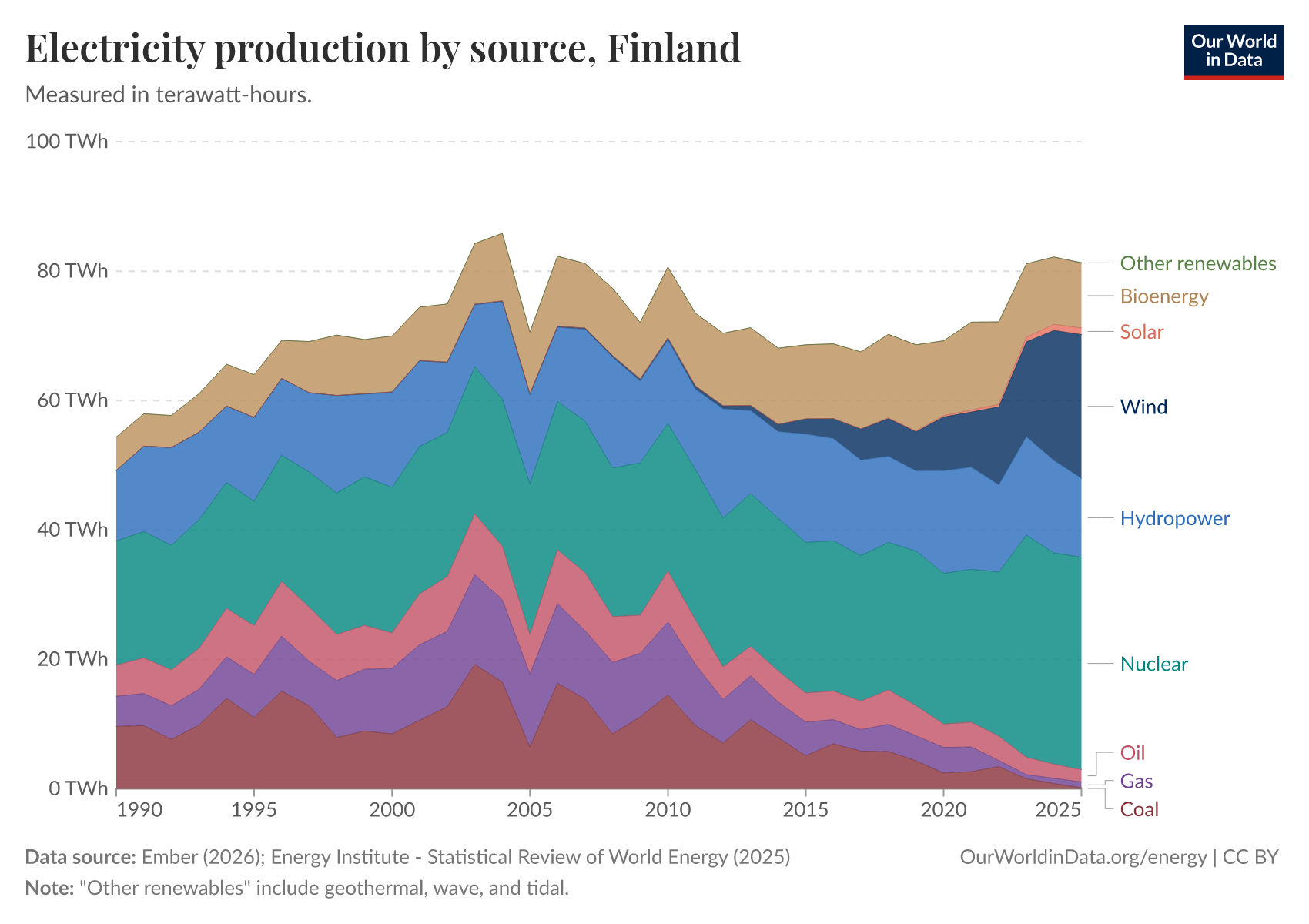
Here in Finland electricity prices can drop to under 1c/kWh due to renewables, basically every time it's sunny and/or windy electricity is practically free (the transfer costs are static though).
A few times the price has actually been negative, people got paid for using electricity due to overproduction =)
There will be connected batteries in every home solving this problem faster than the fossil fuel lobby can come up with a new talking point about why it’ll never work.
I'm not convinced we'll ever see mass deployments of batteries to homes, not because of the fossil fuel lobby but because of the economies of scale from installing grid sized batteries at strategic points in the transmission network.
In California grid scale batteries have capital costs of around $125/kWh to $155/kWh while a home battery might be 20x that including installation.
That's because home battery providers aren't competing on price yet. The market is still small, the risks are high and they need to figure things out.
Once the early adopters run out they will have to start competing on price to make sales. There's no justification for a home battery when they charge 10k for 10kwh as they do now - only early adopters and government subsidies getting it over the line.
IMO home batteries should be a relatively easy install in principle, it's just still in that early expensive phase.
It’s already happening as I write this. An enormous amount of capital and labor are already deployed to find ways to get batteries into people’s homes, and growth is accelerating.


Every solar farm doesn't need to be China Size - it doesn't even need to be a "farm", just put them on roofs.
And don't let perfect be the enemy of good. Yes there are times when solar doesn't produce energy, but there are also times where it OVERproduces.