They should be sweating, because if the other side can fire 100 rockets for $10k that are close enough to not immediately and obviously be off target, and you don't know whether a more expensive one with actual explosives is hiding within that barrage, you now have 100 targets to try to intercept, and suddenly your costs have gone up dramatically while the other sides costs has barely moved.
It is warfare, not mere product delivery. The second you fire one of these you reveal your position, making you a target for immediate reprisal. You don't win wars by losing very fine soldiers on homemade close enough shots.
So mount a battery on a truck, fire, move, fire again. Do that on a few hundred trucks, and drive around places without any real target and you have the other side burning through their arsenal real quick.
This isn't a rocket that is viable when you need to e.g. cross the Persian gulf. But it is a rocket that shows there are potentially viable decoys at a similar cost sufficient to spead fear in an enemy force if you can drive a bunch of trucks close enough to fire off dozens of them each, with the enemy knowing odds are you've hidden a handful of small warheads in there.
It'd be pointless for a conventional force that has the upper hand. It'd not be pointless for a weaker force or insurgency that needs massive asymmetry in cost to stand a chance.
EDIT: Heck, build tiny launch batteries in a crate, and drive around dropping launch batteries with a timer, and by the time the first rocket goes off you might've already dropped 10 of them and driven off. Now every car large enough to hold even a small box is a threat, and you have a real quagmire.
100 rockets for $10k is not happening. The price floor is not dictated by the electronics (which did get cheaper), it's dictated by the rest of the system: propulsion, warheads, arming and safety, QA, traceability, climate and shelf life stability.
Take a look at Raytheon's manufacturing line: https://www.youtube.com/watch?v=kCCkVAHSzrc That's what it takes to have missiles that are nearly guaranteed to perform to specification every time. You can stockpile the packaged missiles in a non-climate-controlled shed for years, replenish them at sea while being showered with salt water, subject them to shock of a nearby blast while in a VLS, and they will still launch, go up to Mach 13, and catch an incoming ballistic missile nearly every time.
Sure, Iran's ballistic missiles are simpler than SM-3, but they are still subject to most of the constraints. They still need perfectly cast large size solid rocket motors that don't crack after being stored for a year, they need warheads that only go off when they are supposed to, they still need to trace every part for QA, etc. There's a vast gap, largely invisible to amateurs, between garage prototypes and stockpiled AURs.
> propulsion, warheads, arming and safety, QA, traceability, climate and shelf life stability.
The further down the list you go, the more optional the requirements get in a sufficiently dire scenario.
Shelf life doesn't matter if you are firing them as quickly as you can make them, especially if you actually can make them as quickly as you need them because they're so simple. QA and traceability may matter less if you just accept that you'll occasionally lose a launcher, and even occasionally have a stray missile land in someone's living room because that's better than having a non-stray Shahed in said living room.
In terms of safety, I bet it'll still beat "cutting open existing munitions and literally duct taping random other fuzes to them", which seems to be the bar for "good enough".
Shelf life doesn't matter if you are firing them as quickly as you can make them, especially if you actually can make them as quickly as you need them because they're so simple.
Right. High-volume users can skip the thermal batteries with decades-long shelf life, and just spot-weld a few AAA batteries inside the weapon. Just stencil the thing "Best if used by DATE". Good for a year or two at least. Skip the anti-corrosion stuff and ship it in consumer-grade shrink wrap. Ukraine ships drones to the field in lightweight cardboard boxes, not rugged weapons containers.
Many US weapons are really old designs. The Patriot went into production in 1980. The Stinger went into service in 1981. There's been progress since then. Consumer-grade parts can do most of what's needed.
AAA batteries don't have the current. Li-Ion is too fussy and has a pretty high self-discharge.
Ukraine can afford the cardboard boxes because they are fighting in their own country. The US has an ocean to cross.
Ukraine can get away with short shelf life because they are at war right now. The US has to stockpile because the supply chain has to run at some capacity in peace time to be able to ramp up quickly when needed, and discarding the produced ammunition after a year would be incredibly wasteful.
Neither Ukraine nor Russia can defeat each others' air defence networks. The US has a lot of experience doing just that, while successfully defending against ballistic missiles. High tier capabilities matter.
The Patriot in 1980 is a very different system from the Patriot that is fielded today. Between PAC-2 and PAC-3, AN/MPQ-65A and LTAMDS it's a cutting edge air defence system. The progress is constantly incorporated.
The Stinger is a bit old, but mostly because the US doctrine has few uses for it. Regardless, NGSRI is coming.
But this is exactly the point: This approach allows for insurgents or parties subject to overwhelming but expensive force to strain the logistics and budgets of their opponent. This is something that would be far more costly for the US to counter.
I don't understand your point. Sure, Ukraine can cut a few corners that western militaries are unwilling to cut. They still can't produce a domestic ballistic missile at scale, because it's genuinely hard, and simple terror weapons like Qassams are useless for militaries. "100 rockets for $10k" is off by orders of magnitude.
100 harmful rockets for $10k is off by orders of magnitude, but that was entirely not the point.
The point is that if you're in a asymmetric position where you can't do much damage directly, then whatever you can do to make the other side waste expensive resources while putting them on constant alert is a win.
You don't need a warhead, or a viable rocket, to do that. You need something that looks enough like a viable rocket to force a response, because the other side knows that x% are real.
If that thing is cheap enough for you to fire large numbers of them, you multiply the problem for your opponent. Cheap enough, and you have the potential to overwhelm the capacity of their countermeasures entirely, at which point you increase the chance that some of their real rockets will make it through.
To "look enough" like a missile that can hit something a hundred kilometres away with enough precision to not be ignored you need a missile that can fly a hundred kilometres. This is not cheap.
I think the point is to look at the US requirements compared to the cost and explore ways that a country could gain strategic advantages by building objectively worse products. (But cheaper/faster, gaining an asymmetric advantage in the offense/defense scaling)
I used to think the US dollars were well spent, because we felt it was morally important to deliver precision strikes which had higher cost requirements. Recent evidence demonstrates that is insufficient when the wetware making the targeting decisions is faulty.
Without necessarily disagreeing with your point, the driving consideration for Raytheon's production line is arguably not reliability. It's being able to charge the customer for perceived reliability. It's very hard to know from the outside how much of it is theatre, even if earnestly arrived at. There are incentives for these things to be expensive.
If you think shelf life, QA, safety, blah blah blah matters when a rocket is 100 bucks, I have just three words: you will lose.
The Ukraine war is being fought with a bunch of cheap toy style drones dropping grenades everywhere. The US got their bases blown to pieces across the Middle East by cheap drones that gently float through the air like a paper airplane in comparison to absolutely any missile.
And let's not forget. The US had napalm, helicopters, bombers, incredible logistics, cutting edge equipment of all sorts. Vietnam had a bunch of sticks in a hole covered in poop. Those sticks sent Americans crying home and we still get movies and games with them crying about how bad it was.
In war between great powers, yeah, high tech works because it's scary and civilians don't want to have that kind of stuff coming home. In a war where civilians are being targeted by great powers who terrorize them by blowing up schools and hospitals, a lot of people are thinking about how many weapons they can make to defend their home and for cheap. If America thinks an invasion is a good idea, they're going to be bringing their 50 million dollar tanks face to face with a few $100 toy rockets. And those toy rockets will be picking off tanks like fish in a barrel while a drone streams it in 4K live to the internet. I really do not think American who support current happenings are ready for the absolute mental torment they're going to endure if this continues.
The vietcong had some incredible technology, courtesy of Russia. Their fighter planes were breaking the Air Force's back, thanks in large part to their far better doctrine. They had the fabled AK-47, the toy drone of its day.
You have a point - cheap drones have changed warfare - but you might be simplifying the issue. As some warfare experts online have discussed, it isn't that cheap drones are the only weapon that is used in Ukraine (or warfare in general), it is one option in vast array of options based on the situation (although, agreed, it is taking on a much bigger significance). Look at the war in Iran. They did a pretty standard playbook and use stealth jets and cruise missiles to surgically take out air defenses in order to gain air dominance. This would be very difficult with just cheap drones.
... but, do agree that cheap weapons are still becoming extremely important. Iran is terrorizing the middle east and strait of hormuz with cheap drones, so they are definitely important. Yeah, in the war of attrition, low cost, high-volume options are clearly very important.
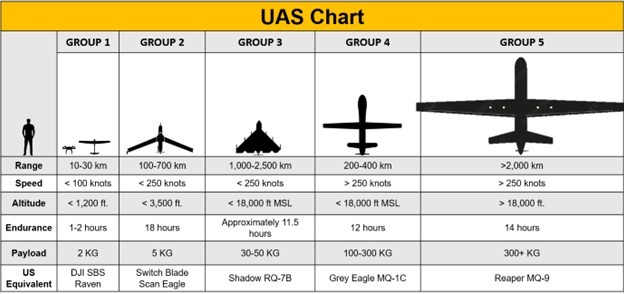
It's fairly important to distinguish what kind of drones are we talking about [1]. Iran's using Group 3 drones.
The GP is confusing Iran's neighbours not being ready to counter group 3 drones with the drones being inevitably effective. These drones are by necessity large and slow, because they need a lot of energy and aerodynamic efficiency to get their range. That means that they are vulnerable to cheap counters, which Ukraine is demonstrating very convincingly: even though Russia is now launching 800+-drone raids, the vast majority is shot down.
Even when those drones do get through, they are extremely inefficient. It's not just that they can't carry a heavy or sophisticated payload (more complex warheads are more effective, but way more expensive), the extremely high attrition ratio forces the enemy to try to target way too many drones per aimpoint. Instead of serving a few hundred aimpoints, the 800-strong raid is forced to concentrate on just a few, otherwise most aimpoints will get no hits whatsoever.
But also the only reason 800-strong raids can even be launched is Ukraine lacking the capability to interdict the launches. 800 group 3 drones have an enormous logistics and manufacturing tail, which a Western force would have no problem destroying way before the raid can be launched. For example, Iran in its current state can't launch such raids. So in practice Iran's neighbours would need to intercept only a handful of drones, which is hardly an insurmountable challenge.
GPS denial is a mixed bag. After about two years of efforts and counter-efforts, the Russians seemingly managed to build GPS receivers that are pretty resistant to jamming.
So much this. Reliability and durability only matters because the thing costs a million dollar a piece. When you have stuff with a mere 5-digits price tag or less, you simply don't care if half of them miss their mark or doesn't fire 10% of the time.
Half of munitions missing means doubling the logistical burden of delivering the munitions to where they need to be employed. The trucks/plains/ships that carry your munitions need to be fuelled and protected, too, so the expense is super-linear, especially when it's a distant war and not a war fought on the country's own soil, like in Ukraine.
Cheap munitions sometimes explode before they are launched, killing crews and destroying platforms.
Cheap munitions mean that CAS is a roulette. You waited for ten minutes for a support fire mission? Sorry, wait for ten more, whatever we launched has failed. Or maybe you're dead because the munition has hit you instead.
Cheap munitions can pin you down. Those cheap FPV drones that are supposedly cheaper than Javelins require dedicated immobile units to launch and guide to targets. Javelins are organic to infantry squads.
Cheap munitions are either very expensive or impossible. There's no cheap anti-ballistic missile and no cheap missile that can sink a warship in the Taiwan strait when launched[*] from Guam.
[*]: alright alright an LRASM would need to be flown closer by an F-35 but the point still stands
> Half of munitions missing means doubling the logistical burden of delivering the munitions to where they need to be employed
It means doubling the transport capacity, but not doubling the burden. A bunch of crates carrying 155mm shell (cheap munitions) is much easier logistically than a PAC-3 missile for the same weight.
> Cheap munitions sometimes explode before they are launched, killing crews and destroying platforms.
Ill designed/manufactured munitions do, but it's not proportional to cost (again, a 155mm shell is a cheap munition even though it's being manufactured and designed in a way to reduce the kind of risk you're talking about).
> Cheap munitions mean that CAS is a roulette. You waited for ten minutes for a support fire mission? Sorry, wait for ten more, whatever we launched has failed.
That's not how it works. You'd launch two at the same time to take the possibility of failure into account (in fact we already do that with expensive anti-air missiles).
> Or maybe you're dead because the munition has hit you instead
Every munition can do a blue on blue strike, we mitigate those through engagement rules, which are calibrated by weapon types.
> Cheap munitions can pin you down. Those cheap FPV drones that are supposedly cheaper than Javelins require dedicated immobile units to launch and guide to targets.
They don't "require" it, it's how they are being employed today in Ukraine. Notice that javelins have pretty much disappeared from the Ukrainian battlefield so it's really not a good comparison.
> Cheap munitions are either very expensive or impossible. There's no cheap anti-ballistic missile
And it's fine to use an expensive weapon for that reason. Nobody is saying no to all expensive weapons (nukes ain't cheap either).
> no cheap missile that can sink a warship in the Taiwan strait when launched[] from Guam.
> []: alright alright an LRASM would need to be flown closer by an F-35 but the point still stands
A Magura isn't a missile, but it has shown its capability of completely shutting down the Black Sea Fleet.
> It means doubling the transport capacity, but not doubling the burden
Which is my point, doubling the capacity at the end of the spear is more than double the burden. The scale is superlinear. The further out the front is (for the US, it's over at least one ocean), the more superlinear the scaling is.
> but it's not proportional to cost
You might've heard of the cheap North Korean shells exploding in barrels, destroying Russian howitzers. It is indeed very disproportional, that's why spending severalfold on better shells is a great tradeoff.
> You'd launch two at the same time to take the possibility of failure into account
It depends on the ability to launch two. Oftentimes it's impossible; cheap FPV drones interfere with each other, or maybe you don't have double the planes to fly CAS.
> how they are being employed today in Ukraine
It's logistically impossible to employ the kind of drones Ukraine is employing on the go and organically to infantry. Features and CONOPS that enable organic employment lead to a substantial increase in per-unit prices, see Rogue 1.
> A Magura isn't a missile, but it has shown its capability of completely shutting down the Black Sea Fleet.
It's three Black Seas worth of distance between Guam and the Taiwan strait. On top of that, nowadays those boats are pretty effectively countered. Overindexing on the war in Ukraine would be a mistake.
> You might've heard of the cheap North Korean shells exploding in barrels,
The problem comes from the shells being “North Koreans” not because they are cheap (and I don't know why you assume they are, by the way).
> or maybe you don't have double the planes to fly CAS.
Spoiler alert, western army do actually fly CAS missions with pairs of planes already!
> It's logistically impossible to employ the kind of drones Ukraine is employing on the go and organically to infantry.
Says who? The Ukrainians where doing just that two years ago, with FPV drones. The doctrine has evolved though because it didn't make much sense to do so in the first place! When you have stand-off munitions that can hit 10-30kms away, you don't give them to infantry to manage like you would for a short-range weapon, and instead you use specialized drone units that are responsible for CAS.
> It's three Black Seas worth of distance between Guam and the Taiwan strait.
You can deploy them from closer range using a ship like you'd do with F35 for AS missiles. And you don't need to attack from Guam in the first place if you're not afraid of the first strike on your assets worth billions of dollars and can disseminate them closer to the Taiwan straight.
> On top of that, nowadays those boats are pretty effectively countered
Lol. Tell that to the russians. The only effective counter they've found being to keep the remains of the fleet locked inside the Novorossiysk naval base (where they've been sitting ducks for flying drones attacks in recent days).
> The Ukraine war is being fought with a bunch of cheap toy style drones dropping grenades everywhere
This hasn't been true for 3-4 years now, most of the combat drones being used now are purpose built kamikaze drones. Notably the Russians are using Iranian designed Shahed 136s, while the Ukranians have the similar Liutyi. Among many, many, many other models in various roles.
> And let's not forget. The US had napalm, helicopters, bombers, incredible logistics, cutting edge equipment of all sorts. Vietnam had a bunch of sticks in a hole covered in poop. Those sticks sent Americans crying home and we still get movies and games with them crying about how bad it was.
While the Americans absolutely lost in Vietnam really bad, the Vietnamese regular army (PAVN) was extremely well equipped with some of the latest Soviet and Chinese equipment. Hanoi was one of the most densely defended anti-air spaces in the world (because the Americans insisted on trying, again, to kill civiliasn to get them to surrender, which never works), with top notch systems. The PAVN had mechanised batallions with tanks, armoured personnel carriers, anti-tank missiles, even amphibious tanks. The air force also had pretty good quality fighters.
The VietCong on the other hand was a guerilla force equipped only with light and mobile equipment.
I'm just not sure what to even say when you're both so assertive and completely wrong. Please stop relying on twitter/reddit to inform your takes.
The war in Ukraine is being fought with all tiers of systems, ranging from Zircons and PAC-3 on the high end to booby traps on the low end. All of them are essential, and shortcomings on any of the tiers is ruthlessly exploited by the other side. Saying that it's only the small drones that matter betrays over-reliance on the gory FPV kill footage.
"QA, safety, blah blah blah" get implemented on every level as soon as it's feasible. You can just look at photos from Yelabuga and see how their assembly lines are not fundamentally different from Raytheon's. Ukraine is standardising their drone manufacturing. This is inevitable, because faulty munitions lead to
- killed friendly soldiers if the munitions explode pre-launch
- wasted logistic resources if they don't launch
- wasted time and targeting opportunity or friendly units not getting fire support when they fail after launch
The cost of faults is severe and much higher than just the cost of the munition itself.
It seems that you're misinformed about the real cost of modern FPVs used in Ukraine. Reports of sub-$1000 drones are years out of date and heavily relied on salvaged munitions, but there are only so many RPG warheads you can get for "free". Current FPVs are heavier, more capable, and cost a few thousand dollars. Further, it's reported that it takes dozens of FPVs to kill a single "hedgehog tank", which brings the total cost of one kill to a rough parity with "classic", "expensive" systems like the Javelin, except Javelins can be carried by a mobile squad, and launching FPVs requires a dedicated immobile unit with a long logistical tail.
Don't mistake forces not being ready to counter low-tier threats immediately with the threats being impossible to counter. Group 3 drones are very effectively countered in Ukraine, to the extent that it takes hundreds to deliver maybe a few TLAMs worth of payload to the target. There are mature systems being rolled out right now across western armies, from various gun-based solutions to APKWS. Group 2 drones are decimated with cheap anti-air drones. Group 1 drones are being handled with APSes, which work pretty well even in urban environments, as Israel has (very unfortunately) demonstrated lately.
So now they're standardizing it, cool. Would Ukraine still be around if they had not fought defended themselves initially with cheap toy drones and waited until they had 4 years of QA, non-combat testing, verifying shelf life, etc etc?
The history of war is a nonstop story of armies who consider themselves advanced over investing in old strategies and technology, then being wiped out by a ragtag group of rebels with cheap tools and new techniques beyond the imagination of the "better" military. The natural process is the new tech works, then improves.
A $100 rocket can easily turn the tide in war. Thinking that means that these $100 rockets will stay as they are and never change is absolutely not the point. Users will continue to refine them while keeping them affordable.
And if you're in a country that's being bombed nonstop, frankly, losing a few soldiers or having launch failures is meaningless. Having one successful missile out of 20 still has more benefit than 0 missile launch attempts and just waiting around for some "better" tech.
And while Japan ultimately lost, they effectively used kamikaze attacks where the pilot dies by design in order to terrorize and slow down an invasion. If they told every soldier to just stay on land and hold a gun, it a land invasion would've been more likely and more messy. And by consequence, since the Japanese were so willing to give their life to defend themselves and attempting so would just mean massive deaths on both sides, America avoided invading the mainland entirely and realized just firebombing every inch of the country would be a much cheaper technique that was impossible to defend from. And firebombing worked because it was dropping very cheap and ridiculously large numbers of bombs.
> propulsion, warheads, arming and safety, QA, traceability, climate and shelf life stability.
You're entirely missing the point.
These do not need to be reliable for the scenario I hinted at. They also do not need to be armed.
They need to be large enough that if one of them is a higher quality rocket (not part of the $10k) that contains actual explosives, you have serious destruction on your hand. Maybe something that looks large enough for that will drive the cost up and we're talking $20k or even $100k instead of $10k.
The precise cost is largely irrelevant, as long as the total cost is a tiny fraction of the cost of a missile interception.
The point is you'd be multiplying the cost assymmetry by forcing a massively outsized response. Because if you don't try to intercept them, every future barrage will include a real rocket. If you do try to intercept them all, you'll be burning through massively expensive interceptors to take out a bunch of cheap toys.
If I was ever considering an insurgency, or a war, I'd be stocking up on vast quantities of toys, with the intent of making every radar constantly lit up by a number of possible threats.
It's a firework-grade rocket with no payload that can't even ignite reliably.
To imitate even a TBM or a MBRM, you need similar kinematics, even if you're running without a payload. Maybe your solid rocket motor would be a touch smaller because you're not delivering hundreds of kilograms of explosives, but it still has to be large because of the rocket equation. With a large motor you're looking at a lot of damage if it explodes at the launch point, so you need quality casting. You can't really save much money on the motor.
Then, you need a TEL. Because the motor is large, the launcher has to be comparable to the real thing. You probably don't want to have two different vehicles, so you keep the same vehicle; it needs to be armed, driven around, and set for launch. Not that different from the real thing.
So you've done all of that, and then you realise that your empty warheads are too light and the missiles (or warheads, if you split) don't interact with the atmosphere in the same way as non-decoy missiles do. What's worse, modern radars are perfectly capable of noticing that and discriminating the decoys. All of that effort, and you didn't win anything. Might as well add the payload.
The US and the UK spent vast amount of money chasing exactly your line of reasoning with nuclear warhead decoys. Chevaline is a culmination of the effort, and it's retired for 30 years. In the end, relying on decoys doesn't really work, they are too expensive.
Fancier CPUs change very little of this calculation, because compute is a very little part of the cost to begin with.
> It's a firework-grade rocket with no payload that can't even ignite reliably.
Doesn't matter at that cost.
> To imitate even a TBM or a MBRM, you need similar kinematics, even if you're running without a payload.
That is relevant in a conflict like Iran at the moment, where the distance that needs to be covered is large. It's not relevant in e.g. an insurgency or the moment you put boots on the ground, where it only needs to look like something potentially explosive coming towards your truck or your helicopter or your people and you have 20 seconds to decide whether to waste munitions on it or not.
> The US and the UK spent vast amount of money chasing exactly your line of reasoning with nuclear warhead decoys. Chevaline is a culmination of the effort, and it's retired for 30 years.
OTOH if you built a successful decoy system that is exactly what you would want people to believe.
> price floor is not dictated by the electronics (which did get cheaper), it's dictated by the rest of the system: propulsion, warheads, arming and safety, QA, traceability, climate and shelf life stability.
I wonder how much of that Ukraine is bothering with. Or Iran. Certainly Hezbollah are building down to a budget.
Last week they launched 200 rockets in the span of one day, about 40 of those fell inside Lebanon border, that’s not counting the number of rockets that did not fire at all.
Probably some fraction of the civilians blown up by Israeli terrorist phone strikes and bombing raids; there's a reason Hezbollah maintains some level of support in the region.
Ukraine does bother with all of that when they can afford it. I'd even say that FPV drones are the main exception, and only because Ukraine was so pressed for immediate results and had stockpiles to repurpose. There are only so many old RPG warheads you can reuse with a detonator made of live wires, and maiming your own launch crews because someone made a tiny wrong movement arming their thirtieth drone of the day under artillery fire gets old fast.
Hezbollah is a terrorist organisation, they don't need their contraptions to work reliably. GMLRS serves an entirely different purpose to rockets made of repurposed telephone poles, and is much more useful for a military force.
Also, don't forget the distances. Ukraine is fighting a war in their own country, with direct ground lines of communication to the frontline. On the other hand, you can fit three Ukraines just between Guam and Taiwan.
That's entirely possible, but doing so reliably and safely is difficult and expensive enough that for a very long time Ukrainians were accepting the risk instead.
The risk appetite countries in existential conflicts have is quite different from what we're used to. For example, there are plenty of videos of Ukrainian soldiers angle grinding cluster munitions open to extract submunitions to put on drones, but that's not a strategy that western armies can rely on.
That depends from which side you are looking. From the other side they are patriots and defending their people and land, sacrificing their lives. Looks like in NATO you haven't seen that. The same in Vietnam, Iraq,.. there is a long list of 'terrorists' of this sort. Almost like 'suffering minorities'.
It's an objective statement of their tactics, not something relative.
Modern precision guided weaponry is meant to selectively destroy military targets. WW2 style strategic bombing was targeting civilian populations mostly trying to disrupt industrial production in support of military action. Randomly firing a few unguided rockets into civilian population centres can't possibly achieve either. The only goal is to provoke terror in the civilian population, therefore it's a terrorist organisation.
You can see similar tactics in the "human safari" the Russians are running in several Ukrainian population centres.