> The complexity goes up tremendously if some condition is rarely encountered: eg leap second. This means it gets pushed to a "corner case" and tested more lightly and more rarely.
There is some talk of eliminating the leap second, which would over time have the Earth and sun diverge with regards to noon and such. One 'answer' to this concern is to have a 'leap hour' or something in the future (some future generation's problem, not ours): but given that people can't even get February 29th correct now, and it happens regularly, I don't see how a one-off event would be made to work. It'd be a huge coördination problem.
Just look at the introduction of the Gregorian calendar: it was slightly off since the time of Julius Caesar, but that minor error added up over time, to the point that to get the equinoxes/solstices back to where they 'should' be 10 days had to be removed with the Gregorian calendar. And because of politics (or a religious flavour) it took a long while for everyone to get on the same page.
> The leap hour will be in 7200 years, around year 9226.
7200 years ago the Neolithic revolution was still in full swing and many of the most famous megaliths like Stonehenge hadn’t even been built yet. The first real state, the Sumerian civilization, hadn’t formed yet in Mesopotamia.
Personally, I’m very comfortable making this someone else’s problems 7200 years from now. If they’re still having basic coordination issues then it’s their own damn problem.
> 7200 years ago the Neolithic revolution was still in full swing
Older folks at Göbekli Tepe grumbled that climate change wasn't real. As far as they were concerned, the Sumer and Indus Valley kids were playing with fire and didn't know squat. The older generation just couldn't understand the crazy architecture over in Egypt and the slangy "new wave" movement at Salisbury Plain. It always seemed that the shiftless youth there just loitered and smoked and invented new expressions to frustrate communication. And everyone could agree that no one liked their so-called music!
I just had a Y10K problem. Customer data was using 9999-12-31 23:59:59 as a placeholder value, and our app crashed converting from the customer's timezone to UTC. I learned that Python datetime can't handle Y10K.
You're missing that the frequency of leap seconds is accelerating over time, because Earth's rotation is slowing down. The leap hour will therefore happen earlier: https://www.ucolick.org/~sla/leapsecs/future2100.svg
Yeah. There’s also the issue that the earth’s rotation is slowing down, so over the long term leap seconds would become more and more frequent. There’s a point when the earth is slow enough that leap seconds need to happen nearly every month, and by that point they are no longer a workable solution to the problem. That is expected to take a few thousand years, comparable to the point where a leap hour would be needed if there were no leap seconds.
Where there fewer hours or were those hours just different length?
Now we have locked in second extremely hard underpinning all of our measurements. But you could consider that you have same number of hours in a day and length of those hours has changed...
A Martian sol (day cycle/rotation) is > 24 hours (by about 40 minutes). Locked in seconds seems to be the easiest for general use mathematically. 24 hours in a day is a bit of a leftover from sundials and 12 being one of the easiest large fractions of a circle and the Earth day was never really a universal anyway, just an accident of where and roughly when we lived. On the other hand, the modern metric second is now defined at exactly 9,192,631,770 periods of Cesium-133 for atomic clocks and other reasons, so a locked second is useful for a lot of reasons.
Leap seconds have so many problems beyond the time adjustment. It's a small/odd enough adjustment interval that there are wildly different approaches like leap smears. On top of being so small, it's rare enough (~every 2 years), depending on how a system is used, lack of proper handling might not be obviously apparent or lack of obvious problem in one implementation ignoring it may lead to lack of care in another implementation which would have a problem ignoring it.
Leap hour replaces all of that with what is more or less equivalent to a change in DST rules (except for more time zones at once). DST changes don't go perfect either by any means... but we do them regularly enough without the world crashing down that doing an additional shift change of an extra hour every 5000 years is almost certainly less hassle and breakage than the leap second approach breaking things every ~2 years.
It is way more easy to let UTC (without leap seconds) just drift away from the zero meridian and move countries to different time zones when convenient. We mess around with daylight savings time often enough that nobody will notice if we have change local time every couple of thousand years.
DST changes are pre-scheduled. Throwing a random hour in/out at (say) June 30, 2029 may be something else. Unless the jump is treated as a TZ change in tzdata?
Yeah you treat it as a time zone change where every zone moves over (or every country moves to the adjacent zone maybe). You can schedule it N years in advance. It's definitely not 0 disruption, but it's very manageable. Regions change TZs or toggle DST frequently enough that we can handle it.
IMHO the correct way to handle leap seconds would have been at the same layer as timezones, i.e. a display-only thing. Timezone databases are regularly updated, you push out leap second updates there. In the worst case, people's clocks are off by one second but all the underlying timing logic doesn't crash.
The problem with TAI is that the rest of the world uses UTC. So you can use TAI on a small island and then you have to convert to and from UTC. My hobby kernel is based on TAI internally. And it constantly converts to and from UTC.
You do not use TAI to communicate with the rest of the world, except for certain special purposes.
As you say, what the computer should maintain internally and for communication with other computers, not with humans, is only true time and not other quantities, like the angles between Earth, Sun and stars.
Only TAI is true time, while "universal time" is an angle and "universal time coordinated" (UTC) and its derivatives are some weird hybrid quantities that can be computed from times and angles.
The conversions between true time and various kinds of official times used by humans are very complex and they should be handled in a single place, not in various places that may handle time zones and discrepancies between UTC and TAI and various other "times", e.g. UT2, UT1 etc.
I fully expect in such a regime, people would be complaining about how the leap second insertion caused their recurring meeting to shift from 9am to 8:59:59
The calendar adjustments are because the planet's constant orbital period isn't a whole number of days.
The leap seconds were an attempt to have wall clock time map to the planet's rotational angle consistently despite the problem that the planet's spin varies unpredictably.
Yes the "leap hour" is a legal fiction of course. In reality in the event anybody cares about this in the distant future they will make the kind of "drastic" changes you've probably experienced twice a year for your whole life and barely noticed... More likely because the drift is so incredibly slow they won't change anything.
So lunar tidal forces are slowing the rotation, but (recently?) Earth mantle/core is causing a speed up, but climate change and melting ice is contributing to the slow down side:
The general trend is slowing down. Apparently (?) once the day gets to be 24h+0.001sec (+1 millisecond), a leap second would occur about every 1000 days; then when it becomes 24h+0.002sec, a leap second would occur about every 500 days; when it reaches 24h+0.003sec, a leap second would occur about every year; etc.
I believe Vancouver is west enough in its time zone that Daylight time is going to be closer to Solar Noon in Vancouver (plus about 15 minutes? I haven't done the exact math) than Standard time was (minus about 45 minutes?). Vancouver is the economic heart of British Columbia and near enough to the centroid of BC's population that BC may have made the best choice they could for solar accuracy for the majority of the population.
> One 'answer' to this concern is to have a 'leap hour' or something in the future (some future generation's problem, not ours)
A simpler solution: we already have an offset between local time and coordinated time, just change that offset. So, for instance, Brasília Time, which is currently UTC-03, would become UTC-02 or UTC-04, depending on which way the change went.
> There is some talk of eliminating the leap second, which would over time have the Earth and sun diverge with regards to noon and such
“Over time” really glosses over how much time it would take. In 500 years there might be half as much divergence between solar noon and 12:00pm as we intentionally inflict on ourselves with DST, or that France and Spain inflicted on themselves in the 1940’s so they could share a time zone with Germany. By the time anyone will even notice we will probably change time systems for other reasons anyway. It’s not even remotely comparable to the Julian/Gregorian issue, which dealt with leap days. Each day has 86400 seconds.
>There is some talk of eliminating the leap second
The concern, of course, is that some universes eliminating them while others don't can puts us out of sync. This creates a wobble that could potentially throw us out of Hilbert space.
> to the point that to get the equinoxes/solstices back to where they 'should' be 10 days had to be removed with the Gregorian calendar
Note that the equinoxes and solstices are officially supposed to be on the 25th. By the time of Julius Caesar, that had diverged, but the divergence in reality made no impact on the date of the official solstice. The Gregorian calendar could easily have put the solstices back on the 25th, but chose not to.
By the time of Julius Caesar, the solstices were on the 25th, which is the reason why Christmas is celebrated on that day.
The Gregorian calendar has not restored the time of Julius Caesar, but the time of the First Council of Nicaea (325 AD), when the rule about how to compute the date of the Easter was established.
From the time of Julius Caesar to 325 AD, more than 3 days of drift had accumulated, so the Gregorian calendar would have required 13 or 14 days of correction.
When many countries transitioned to the Gregorian calendar much later, they had to add additional correction days to the initial 10-day difference, about 1 day per century.
Unfortunately, the Gregorian calendar has not restored the time of Julius Caesar, but the time of the First Council of Nicaea (325 AD), when the rule about how to compute the date of the Easter was established.
For the time of Julius Caesar, about 3 more days would have been needed, which would have made the Christmas coincident with the Winter Solstice, and which would have made much more sense.
> There is some talk of eliminating the leap second, which would over time have the Earth and sun diverge with regards to noon and such.
<rant> It won't happen on a human scale. So why oh why do we screw around with this moronic leap-second nonsense ? Oh dear, in the year 4000 noon will arrive three minutes earlier compared to now. So? </rant>


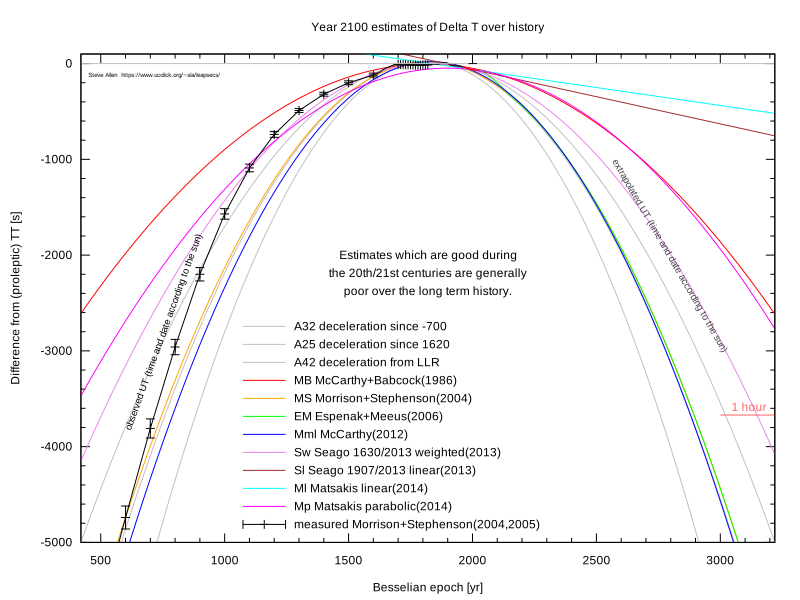
There is some talk of eliminating the leap second, which would over time have the Earth and sun diverge with regards to noon and such. One 'answer' to this concern is to have a 'leap hour' or something in the future (some future generation's problem, not ours): but given that people can't even get February 29th correct now, and it happens regularly, I don't see how a one-off event would be made to work. It'd be a huge coördination problem.
Just look at the introduction of the Gregorian calendar: it was slightly off since the time of Julius Caesar, but that minor error added up over time, to the point that to get the equinoxes/solstices back to where they 'should' be 10 days had to be removed with the Gregorian calendar. And because of politics (or a religious flavour) it took a long while for everyone to get on the same page.