I agree that population looks likely to shrink, especially across much of Europe and Asia; in reality even without that, population growth tends to look rather more like a logistic function than an exponential anyway which makes the analogy a bit silly.
I don't think this necessarily means we will see economic degrowth though. A common mistake is to equate economic growth with the use of more natural resources or a greater population. Neither of these are needed for economic growth to occur - a lot of it is really driven by finding ways to use less natural or labour resources to achieve the same end, meaning more of that end can be achieved for the same cost. I'm far from convinced we're at the plateau of human ingenuity and our ability to drive efficientcy improvements in everything we do.
> a lot of it is really driven by finding ways to use less natural or labour resources to achieve the same end, meaning more of that end can be achieved for the same cost
Yes, and I think that's what's been cushioning the blow in Japan.
Eventually the growth in economic activity must end though. It has to be constrained by something in the physical world, be it resources, energy, or build-up of waste products. There's even a limit as to how much waste heat we can produce on Earth.
But moving beyond Earth buys a lot more room for growth, and I expect that will eventually happen.
> If you just plot it out you’ll quickly exhaust the entire universe.
Not even the universe: assuming you get off-planet in the first place, you'll find that exponential growth of any amount will sooner or later outstrip the cubic-law increase in accessible volume of the sphere of space you can expand into at light speed.
To put some numbers on it, at a 1% growth rate starting with the current population in around 12100 the volume of space we could theoretically have access to (a sphere with a radius of 12100 light years), the amount of volume available per person would be under 0.06 m^3, which is what the Internet tells me is the volume of a typical human.
Of course we couldn't get anywhere near that, because that 12100 light year radius sphere doesn't contain enough mass to make that many humans. At 1% annual growth here are some of the mass bottlenecks we'd hit.
3400 years for the mass of living humans to equal that mass of the Earth and Moon. 600 years after that we would equal the mass of Jupiter. 700 more years and we equal the mass of the entire solar system. 2000 years after that (or 6700 years from now) we'd need the entire mass of the Milky Way to make those humans.
From there it is just another 100 years until we need the mass of the Andromeda galaxy.
Another 5500 years (12300 years from now) and we'd need the mass of the entire observable universe.
You are causally talking about collapse and all the misery it will cause. We need to get to a steady state (or controlled decline) or face extinction. Unlike bacteria or other animals, we have the potential to prevent 'natural things'.
It's been happening in Japan for a while now. I don't think misery is the right word for it. Adult diapers have been outselling baby diapers there for a while now. Maybe it hasn’t progressed far enough to judge yet.
As long as it happens at a slow enough pace for us to adapt, it could be alright.
I wouldn't want to depend on social security or pension programs for my retirement though. Those systems would collapse in an environment where the aging population outnumbers the working population that drastically.
Oceans will be probably without fish before 2040 due to overfishing. 90% of sharks are already gone, without them the whole marine ecosystem collapses.
Not sure where you're going with this though. Your point is things are going to hell, so a gradual decline in population, growth, and economic activity wouldn't be as good as a hard crash?
> a gradual decline in population, growth, and economic activity
No time for that, probably. And it's not even on the horizon ... all policies have economic growth encoded in them. We're not even thinking about slowing down.
We're not talking about/doing degrowth, afforesting, reforming industrial agriculture, abolishing animal agriculture, making a dent if fossil fuel consumption, stopping overfishing and biodiversity loss ... we don't really do anything, instead just dream of blocking the sun with sulphuric aerosols and leaving for another planets.
Hard crash, and soon, would be probably better. More resources for the civilization that comes after this one.
Humans have figured it out many times in history how to live sustainably but keep forgetting. When the Europeans came to the Americas, they found people living sustainably. They thought these people were primitive and have never experienced civilization. Well, it turns out they were the people that remained after civilization collapse and have adapted to live sustainably so they wouldn't repeat what the Europeans created. North and South America had, at some time, cities far larger than any in Europe before those civilizations collapsed. For example, the mound builders along the Mississippi.
What's different today is we have now a GLOBAL civilization thanks to globalization. With many of the same features across people's and economies. Humans have never dealt with global risk like we do today.
> We're going to have to figure this sustainability thing out though
It may be already late. I wish it wasn't so. I think we could have chance at repairing it ... if only we would do what's necessary. But we're not doing what's necessary, we never started even discussing it, and I'm starting to doubt that we'll ever do. We're talking only about climate change, but that's only one of the symptoms of the overshoot. Even people @ hacker news mostly don't have a clue.
> we can't just ignore the problems
We've been ignoring them for 50-70 years. The limits to growth / club of Rome was in 1972? So far ... we did nothing but ignored the problems.
We may cross the 1.5C threshold in 5 years. Not in 2050 as previously expected, but in 5 years. And we're still pursuing economic growth. Have you noticed any evidence to the contrary lately?
> it's going to be a big challenge, and things may get ugly
I recommend few videos for you. I must warn you ... it may hamper your ability to enjoy parties.
Collapse: The Only Realistic Scenario - Arthur Keller
ok, what if all those old people would get to be fit enough to do stuff?
how long would, or rather _could_, they really chill? All the old people I know wish they
were fit enough to be productive and constructive. Drugs and tech will provide this opportunity at some point in the near future.
And what is all this nonsense about social security and pension systems breaking down because the aging population outnumbers the working population??? Think about the exponential function. Everything will get more efficient. Up- and recycling, too. We only consume so much because nature had no way to be more efficient. That's where freaking sentient human beings come into the picture. And AI. I really don't understand the pessimism. If we set up an account on the wall street for every citizen of the planet and let robots do their magic, nobody would lose, everyone would gain. How? "MAGIC". I'm kidding. By ways of the exponential function. You can simulate it yourself. Are there more and more ideas waiting to get on the market or less? To fulfill some desire or need, to fix something that urgently needs fixing? More and more and it will never end. The amount of desires will keep growing. And everybody is misunderstanding the expanding universe. What do you think 100 cooperating billion humans will do? Cooperating in a decentralized way, how most of the economy works, minus the bad top level management and the inefficient ways of the stock markets (the greedy people). When has the human brain become sentient? And so incredibly powerful? After it grew to about 70? 80? 100 billions brain cells?
I'm in my thirties and so is my brother. We now laugh about the ways our parents grew stuff and procured food and stuff. And we realized that it took us so long to understand so many things because our psycho-social environment was too busy being drunk. Which is fine, because the top level management of the professional, local, regional, national and global systems are incredibly incompetent and nobody wants to harm anyone and or go to jail and leave the family worse off. We were slow for multiple reasons but now that we are catching up with the rest, and more importantly, our own potential, things will speed up exponentially.
I take care of the tech side and he gets into the whole sustainable gardening side of things. There is enough water and enough energy sources. The only problem to solve will be the chemicals in water, ground and air, but we are positive that there will be progress in the many approaches we have already found online and offline.
I used to like the term "self-fulfilling prophecy" until I understood it is equivalent to "the purpose of a system is what it does". People get smarter and improve systems. It's a beautiful and never-ending story.
I'm doubtful on the largest scale. Fucked is decreasing complexity / un-fucked is increasing complexity. The relationship between those two things and entropy is at least an open question - i.e. Entropy has been increasing in the Universe since the beginning but the complexity of life on Earth has been (arguably) increasing over time.
I'm not saying peaches and cream but - we use stuff, there's limited stuff and so we're screwed - is to my mind an over simplification.
All humans get an account on the stock markets and all those accounts are run by robots.
[Hyper Light Version]
Robot 1: Winning.
Robot 2: "I'm losing, need to improve, copy winning moves of robot 1"
Robot 1: "I'm losing, improve by adapting to robot 2, wait wtf."
Calculating ...
Robot 1: "Ok, we're good, I'm not making as much, but this way I will never reach a limit."
Robot 2: "Same."
Robot 1: "Sweet, wanna jam?"
Bacteria also multiply at an exponential rate, ergo, we're fucked.
Rats also multiply at an exponential rate, ergo, we're fucked.
Ants also multiply at an exponential rate, ergo, we're fucked.
Oh wait, we're not overrun by bacteria, rats and ants you say? The Malthusian argument has some obvious flaws that have been well documented over the decades. The real story here is that serious people still fall for it.
> Bacteria also multiply at an exponential rate, ergo, _they're_ fucked.
> Rats also multiply at an exponential rate, ergo, _they're_ fucked.
> Ants also multiply at an exponential rate, ergo, _they're_ fucked.
And he'd have been right. Horrible things happen to those populations when they grow too large.
If you want to talk about Malthus being wrong, that has to do with human inventiveness, disease, and war, among other things, throwing off his simple extrapolations.
Highly recommend the YouTube channel Primer and the simulations he does to get an intuitive understanding on why, for example, finite resources lead to logistic growth: https://youtu.be/uRTtlpD_U54
Sank uu. Before I watch that video I want to say that people, even smart and educated ones, don't understand the exponential function. It applies to everything, including evolution, including the poor, the working class and the ways humans merge with tech and nature. Some people just consciously decide to opt out ... and many of those opt in again, once the solution are convenient enough.
Too much progress has been lost because the top kept the lower 50% below their potential.
And even though the bottom 50 % know very well who is responsible for the state of the planet, the supply chains of the top 13 %, there is no anger and no hate. Most of them will go nuts in terms of productivity, if you give them UBI. If I think of the German-[insert any eastern country], there is not a single person who will sit on their ass and do nothing. And they won't go all self-sufficient and all that jazz, absolutely not. They will join the markets and increase the margins of all the investors. It took me a long time to understand why so many people misinterpreted the potential of the working class. They are proud about what they do, they gladly help and grow anyone's wealth, as long as you give them what they need to thrive. The ROI would be super freaking hot. Don't take my word for it. Try it.
1. The planet is not a closed system. For what matters the planet has an infinite stream of (solar) energy getting in. So, no, we are not on a finite planet.
2. The plants do a pretty good job with the solar energy, is there some technical impossibility for humans to do the same?
3. Exponential growth can keep going for a while outside of the planet, the universe is pretty big.
Agree: with such a lack of imagination we are doomed.
But we have the ability in the future, the distant future, to mold and shape the solar system as we please.. there is always new Mass, new matter, coming into the solar system from other star systems nearby, this new matter can be used to create new planets even a new star.. and who knows faster than light travel may come along
This is exactly what prompted Alfred Russel Wallace to propose his theory of evolution to Darwin (who happened to have the same theory). Given the number of babies that die, the selection force drives the harmonization of the species to the environment. Wallace compared it to the governor of a steam engine — a cybernetic control system.
If it were merely a matter of harmonizing our behavior with the environment so we could continue along in steady-state, that would be fine.
Unfortunately there's this concept also from control theory called overshoot, that we are almost certainly past the threshold for, by a lot... although how much depends on what near-future technologies become available to reduce the gap between where we are and the Earth's carrying capacity.
There are two issues: (1) growth rate isn't constant, it peaked 60 years ago (2) resources are not "fixed" when technology is taken into account, which is why estimating peak oil has been so difficult.
Energy Return on Investment (EROI) is a ratio used to measure the amount of usable energy that can be extracted from a particular energy source compared to the amount of energy required to extract, process, and distribute that energy source.


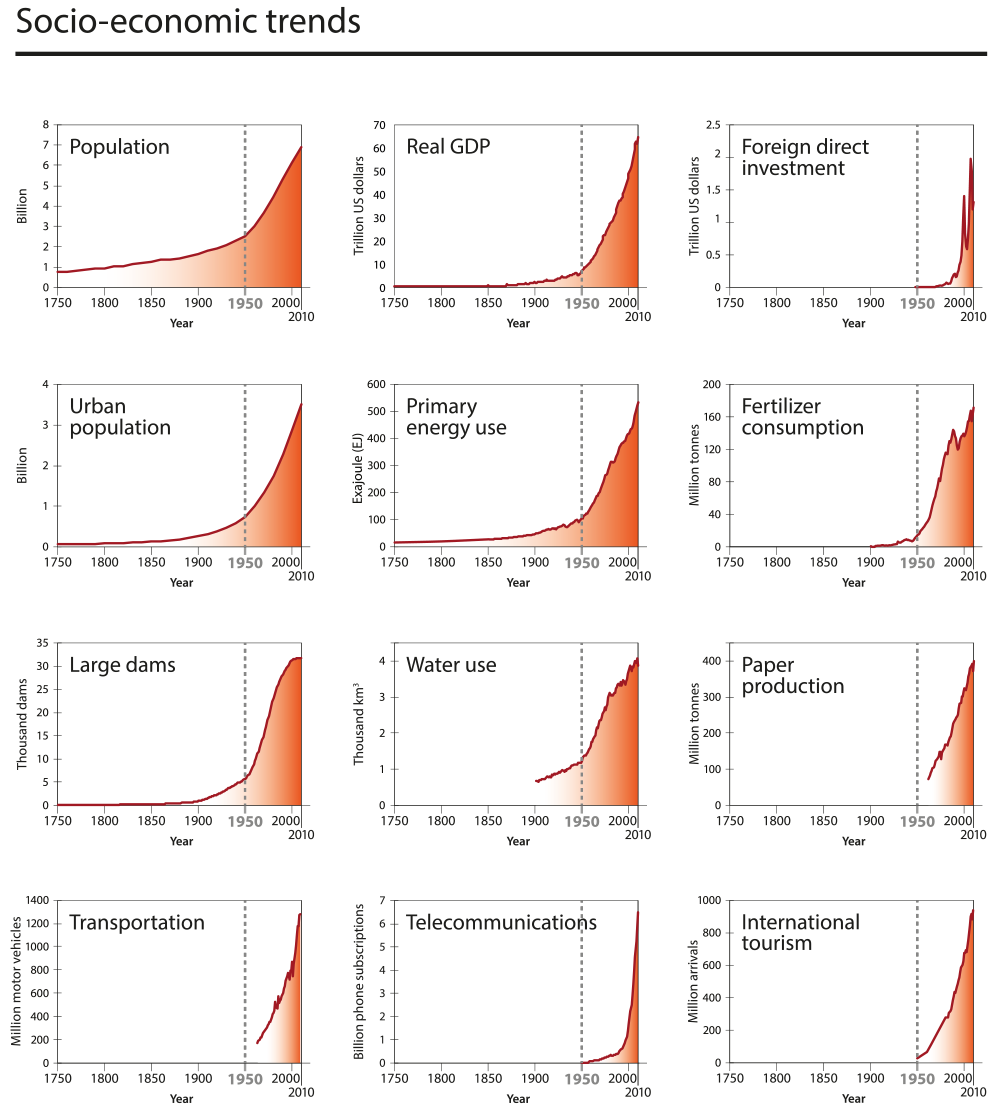
So a society, economy, or civilization predicated on growth would have to adapt to a steady state, or at least more controlled linear growth.
I think that’s what will just naturally happen. Current forecasts call for the global population to shrink. The economy will follow.