It was electrifying. Understand that by 1984 there were millions of Americans using computers with a command line interface. While they could all do game graphics, you always started out in text mode and had to learn incantations that are familiar to many users of this site but which are no longer a part of most users’ daily life: dir, cd, del, etc.
Seeing how dramatically different a computer experience could be was like opening a door to an alternate universe for people. The day after the Super Bowl in 1984 when their famous big Brother commercial ran, my girlfriend’s computer-illiterate father announced to us “I know how to use a computer now” and of course I knew exactly why.
I would urge developers to also take a look at the early "Inside Macintosh" series, which tried to explain Apple's Human Interface Guidelines to programmers. Take a particular look at Vol1-Chapter 2 [1] to see how hard Apple worked to explain how to design consistent and usable apps. All of this advice ("avoid modals", "group commands in menus") seems trivial to us now: that's how GUIs have worked for most of our lives. But prior to Mac most apps looked like vim. These ideas had to be designed and then taught, and Apple spent a huge amount of effort on those books.
Also worth reading is Tog on Interface by an early Apple employee who was Apple's Human Interface Evangelist in that period. One particularly interesting essay goes into the issues associated with the way that developers are used to dealing with abstract models in a way that many users aren't. (He bases his argument in part of Meyers Briggs which is astrology to some degree--but the basic point stands.)
Yes, the shift of consumer computers from command-line only to graphical interfaces would have been bigger than the Wizard of oz moment where the movie transitions from monochrome to colour.
I contrast this to Meta VR's comically atrocious demos and wonder what happened.
> I contrast this to Meta VR's comically atrocious demos and wonder what happened.
How so? They’re showing the best with the limits of current mobile technology that can maintain 75Hz. Cloud VR isn’t here yet, because 5G isn’t here yet. In 5 years, some of those limits will be gone, 10 years even more, but it would be silly if they waited 10 years to start.
I think part of the problem is that you can’t take a picture of VR and show it to someone. It doesn’t translate. Things that look ugly in 2D look much better in 3D. This is a huge problem with VR game trailers.
For example, the new avatars looked much better, “in person”, than with 2d screenshots. 3d is a very real part of our perception that I think many things can benefit from, especially data visualization.
There is a aphorism that goes like "good technology is indistuishable from magic".
What gain is there in publicizing these half assed updates that don't inspire any consumer confidence?Except to maybe vested parties like advertisers and, shudder to think, metaverse real estate agents.
I’m sorry, but no technology has started in its final state. Metas communication has been very very clear that we’re in the infancy of it all. See the latest keynote for multiple examples.
Steve Jobs had at least enough product sense to avoid releasing the iPhone and iPod for years while they were in early development.
Meta has none of this.
Apple succeeded (and succeeds still) because of the company’s culture of obsessiveness. The original motto of Facebook was “move fast and break things” which might have worked well for an evolving social media darling but it’s not surprising that they’re failing constantly at shipping real world products.
John Carmack (now a Meta employee) openly complains that he’s not happy with their expensive unaffordable product that has terrible performance for users. Taking this analogy further, in this case Meta is like IBM with a research facility developing expensive GUI prototypes, just waiting for an enterprising startup to rehash their ideas into something affordable, enjoyable, and usable for most people.
Because Meta is just not the player to innovate VR. It has existed for a very long time, and Meta hasn’t been able to go any further than games that already exist long ago.
> Meta hasn’t been able to go any further than games that already exist long ago.
The Quest Pro is, literally, the “further”, outside of games. Check out the keynote! As was stated in that keynote, there's still a long way to go.
I don't think this perspective that meta is responsible for all the software makes sense. They're building a platform/framework for everyone to innovate, not just themselves.
As someone who codes in VR a few times a week (B&W passthrough version of this [1]), I think it's the future of display tech.
Or what about `himem`? I remember I had to do that command first. Otherwise, something in railroad tycoon or Civ would not work. I don’t recall exactly what it was, the pointer, high res colour graphics, or sound or maybe the combination of the above. I just knew I had to type that first. Didn’t have a clue at the time what it was.
Come dos 6 there were menu options in config.sys you could use to load different parts of your hardware depending on what you wanted, they also could do different things in autoexec.bat too. Before that you could just have different boot floppies.
My memory had himem.sys as a config.sys option though, with various numbers you could pass to it. EMM386 was another one too.
It was tricky to work out what you could do - a lot of trial and error, this was in the pre-internet time (at least for the typical home user), so things tended to come from hints in magazines.
Wow, I remember this! As a kid, I remember taking my computer to an IT shop asking how to run a copy of Ultima VI on my Pentium II MMX PC. The tech there had it for a week, and they figured it out by setting up autoexec.bat so that I had to allow/disallow some processes from booting one by one.
Apparently one of those tricks was reducing the amount of available memory, or something like that. That was the hack that got U6 to boot and be playable at a normal speed.
This would have been in 1998 or so, so my memories of the exact fix are pretty faint.
To be fair, the Mac alternative at the time was "Don't do that." DOS and the PC (and add-ons like expanded memory) provided a bunch of ways for sophisticated users to do things that weren't quite possible with stock configurations. (Basically there was memory between 640K and 1MB that could be used in various ways but it required the right incantations.)
My general recollection from being a DOS power user (and developer) and a very sometime Mac user in that era was that Macs were less likely to be "problematic" but when something did go wrong, you had far fewer tools and observability to work around the problem.
The Mac from that era had a built-in hardware debugger. Literally pressing the button on the front of the case dropped you straight into Macsbugs. Something I used extensively to crack software copy protection.
If you knew Macsbugs, ResEdit and Codewarrior you had complete control of your software and hardware.
>>Literally pressing the button on the front of the case dropped you straight into Macsbugs.
Or better yet, TMON[1]! What an amazing debugger. I spent many hours in there, trying to figure out why the 64K ROM was stepping all over registers that were supposed to be protected by particular ROM traps. (to be fair, there were not too many of these, and they were all eventually patched by system updates)
That period didn’t last very long, though — by 1986, the Mac Plus had a megabyte of memory standard, and still a flat address space — no HIMEM required.
On the second point, generally the hardware was reliable, and Mac users had tools available to diagnose software issues. There just wasn’t any printing stuff to a console.
> To be fair, the Mac alternative at the time was "Don't do that."
Well, no. The Mac alternative to DOS TSRs that loaded in High Memory would be Desk Accessories.
>Introduced in 1984 as part of the operating system for the Apple Macintosh computer, a Desk Accessory (DA) was a piece of software written as a device driver, conforming to a particular programming model. The purpose of this model was to permit very small helper-type applications to be run concurrently with any other application on the system. This provided a small degree of multitasking on a system that initially did not have any other multitasking ability.
Credit to @Stammy on Twitter who shared this over there. Thought everyone here would find this pretty cool. I'm a sucker for this era of advertising. This is a particularly beautiful spread, and super cool to see a snapshot of that moment in time and how Apple was positioning this brand new product.
Also a sucker for this kind of advertising. Advertising used to have a lot more copy. I have a book full of this stuff from Taschen called, appropriately, “The Copy Book.”
As I recall (it's been years), David Ogilvy's Confessions of an Ad Man has a bunch of examples of this. Yes, a lot of advertising used to be very copy heavy and that's almost disappeared (or at least migrated to other forms like content marketing).
Agreed! I was also reminded how Apple's marketing has been so good for nearly 40 years - if you look at other tech ads from the early 80s, they're nearly always overloaded with tech jargon and don't nearly speak as well to the "what can I create with this?" question that Apple does.
Also, though, it's always interesting to reflect on the ways society has changed. I am 100% sure no copy editor would allow "Goo Goo Gai Pan" to be the name of their fake baby food today, nor lines like "Yuppie generation now breeding like bunnies."
Worth reading "Ogilvy on Advertising" if you're into this stuff. I know Ogilvy & Mathers (famous advertising firm) had Apple as an account in the mid 80s.
Is this a fact? I know that Ogilvy & Mather did a lot of famous work for IBM, while Apple's main agency was Chiat/Day for years, if not decades since at least 1983. Chiat/Day created the iconic "1984" TV ad as well as the "Think Different" campaign, among lots of other famous Apple ads.
There's a great book "Chiat/Day - the first twenty years" with a lot of ads for Apple and other brands.
I was curious about the sales impact of the 1984 ad, so I did a little googling. It turns out you're right (see [1] and [2]).
Steve Hayden created the 1984 ad while at Chiat-Day. He later went on to work for Ogilvy, so that's probably where the mis-attribution came from.
What's interesting is that he's the same person who created the Lemmings ad a year later. The 1984 ad resulted in a huge boom in sales. The Lemmings ad did just the opposite. Apple closed a bunch of plants and had a big layoff. Then Jobs left Apple. weird turn of events.
You're right; I'm sorry to have spread disinformation!
Looks like Apple switched from Chiat/Day to BBDO in 1986. Around the same time Steve Hayden made the same move... and Steve Hayden didn't move to Ogilvy until 1994.
I have Ogilvy on Advertising, found it cheap at a used book store.
The book is worthwhile for all the examples of real ads done by his agency. The writing itself is nice, but hugely out of date, as it describes a pre-internet, largely brand and image-driven approach to creative ads.
In America, the "Yuppies" -- Young Urban Professionals -- are having babies at an unprecedented rate. And literally nothing is too good for these infants of the affluent. In fact, they're called Gourmet Babies! So we propose to offer traditional Yuppie foods -- sushi, pasta salads, brie cheeses, etc. -- in baby food form.
That business model work work today. Say what you will about Apple, they really know their target demographic.
I imagine this terminology was also carefully chosen as a trendy word that would catch the audience’s attention as a “mass media in-joke”. In 1984, the kind of person who read Newsweek would certainly know term “yuppies”, there was a bit of a panic in that time period about all these young folks moving to cities and then gentrifying neighborhoods with their high-paying jobs (typically in finance). Of course, it was precisely the yuppies who Apple needed to buy the Mac, what with their disposable income and progressive attitude toward technology.
Funny enough, Newsweek’s final cover of 1984 declared the year to be “The Year of the Yuppie”:
That sort of thing carried over into Jobs' next company NeXT. Look at the left hand page (linked below) and zoom in. It's a press release for a new (fictional) blues album that would appeal to the "hip" audience NeXT was hoping to target.
The problem with Apple's extensive advertising was that they ended up having to price the Mac higher than an individual could afford so they could cover the marketing budget. Combined with the lack of software and the small amount of (non-upgradable) RAM, this meant that Mac sales slumped after the initial rush of early adopters. More information: https://www.folklore.org/StoryView.py?project=Macintosh&stor...
> The problem with Apple's extensive advertising was that they ended up having to price the Mac higher than an individual could afford so they could cover the marketing budget.
Andy Hertzfeld is indisputably a genius that was at the right place at the right time. He's a decent writer, and his easy personality shows through his writing style. That said, he was a software developer, not a marketing specialist. Advertising is only important to sales and image, and little else. I don't claim to understand how, because I can barely believe it myself, but advertising has a direct correlation to increased sales and revenue such that the more that is spent on advertising, the more sales and revenue there will be, and this is unrelated to product price. Maybe the sales slumped, or maybe whatever market there was for the 128K Macintosh in 1984 was quickly saturated. Maybe even the price, as high as it was, wasn't high enough. It is also possible that with less advertising and an amazing affordable price that Mac would have failed and Apple would have gone under. It's hard to say, but what did happen is that Mac succeeded and Apple survived, no worse for the wear for spending a lot on advertising and selling Mac at much higher prices, at least during the mid-1980s.
It should have been cheaper. The thing you’re overlooking is that the 1984 Mac was not actually a market success. Success required more memory and the LaserWriter. The Apple II carried Apple until sometime in the late 80’s when people finally started buying Macs for desktop publishing.
> The thing you’re overlooking is that the 1984 Mac was not actually a market success.
You are mistaken. "The Macintosh was the first successful mass-market all-in-one desktop personal computer with a graphical user interface, built-in screen, and mouse."[1] 70K were shipped within the first 100 days of the announcement,[2] which is a sale every two minutes every hour of the day for more than three months, generating $174.6M in revenue and representing fully 1% of the existing home computer market in just over 3 months. That is actually market success by any measure.
The following year in 1985 the Amiga 1000 with all that extra graphics hardware apparently cost 1295 USD and Macintosh MSRP was 2495 or 1995 depending who you believe.
Amiga folks always overlook Apple’s emphasis on user experience. The Amiga workbench UI at the time looked like an Apple IIe high-res mode if someone had forgotten black and white monitors existed. Everything was ugly blue / orange combination and the graphics seemed chosen to emphasize pixel bulkiness. Put that and the 1985 Finder head to head and the user walks out the door with the Mac.
Something like DeluxePaint vs MacPaint would be a much different story, easy Amiga win. However, pretty much every user considering a computer would need word processing, where again the Mac had a rock solid look and feel advantage.
Yea, I did not like the Amiga. It just felt cheap. The low resolution "high res color graphics" were just Not Good compared to the crisp B&W Macintosh graphics. GEM for the Atari and PC suffered the same problem, it just looked terrible. Even Window 1 and 2 looked better than either of these.
The singular interesting thing from the Amiga was that you could drag down the current screen and reveal a screen beneath.
I never spent any time with the Amiga, to be fair, but I was off put enough by initial perception to not really even want to try.
Almost didn't. Apple ][ revenue kept the doors open until I think it was 1986 when they were finally break-even on Macintosh. And it cost Jobs the company. Then he came in as a hail-mary and got $150mil from Microsoft to stay in business a few extra months and if he hadn't had those 11 years at Next Inc which also went bankrupt, OS X probably wouldn't have happened.
The stars aligned for Apple a few times: I think it's Apple ][, iTunes, iPhone in that order.
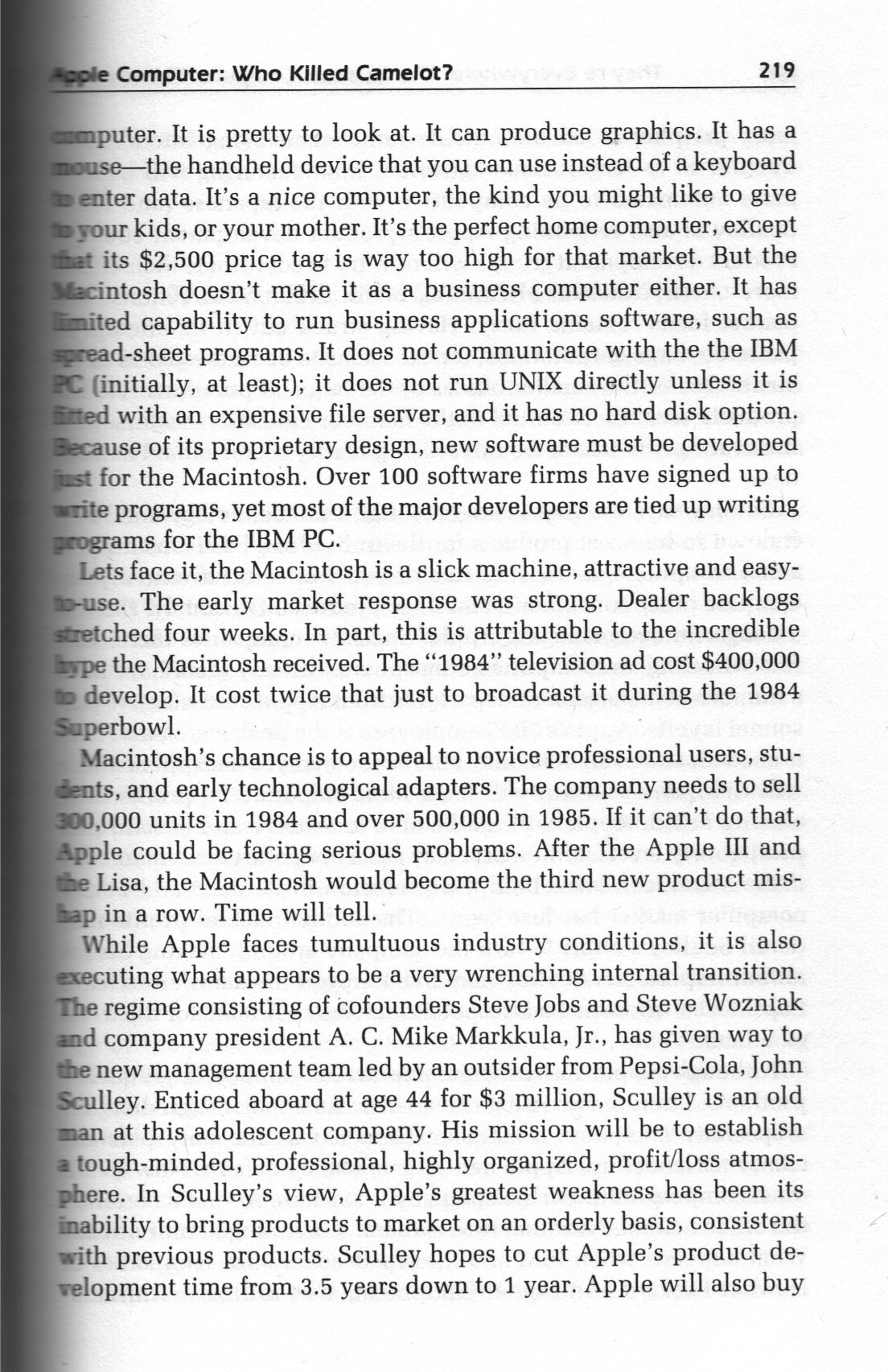
Here's an example from my personal library from a 1984 text, "The coming computer industry shakeout" which sadly hasn't been digitized: http://9ol.es/computer-shakedown-219.jpg
1984-86 were pretty dark times for Apple if you're to go off of what people were saying between 1984-1986.
The lawsuit "Apple Computer v. San Francisco Canyon Co.", filed on December 6, 1994, alleged that the San Francisco Canyon Company used some of the code developed under contract to Apple in their additions to Video for Windows. Apple expanded the lawsuit to include Intel and Microsoft on February 10, 1995, alleging that Microsoft and Intel knowingly used the software company to aid them in stealing several thousand lines of Apple's QuickTime code in their effort to improve the performance of Video for Windows.
On March 3, 1995, a Federal judge issued a temporary restraining order that prohibited Microsoft from distributing its current version of Video for Windows
[…]
In August 1997, Apple and Microsoft announced a settlement deal. Apple would drop all current lawsuits, including all lingering issues from the "Look & Feel" lawsuit and the "QuickTime source code" lawsuit, and agree to make Internet Explorer for Mac the default browser on the Macintosh unless the user explicitly chose the bundled Netscape browser. In return, Microsoft agreed to continue developing Office, Internet Explorer, and various developer tools and software for the Mac for the next 5 years, and purchase $150 million of non-voting Apple stock
> Then he came in as a hail-mary and got $150mil from Microsoft to stay in business a few extra months
This is another HN myth like “cable was once ad free”.
Before Amelio was kicked out, he had secured $4 billion in financing. If you look at the series of events, it is completely illogical thst $150 million could have “saved” Apple. The deal happened in 1997. Apple wasn’t profitable and just barely until 2000-2001. $150 million couldn’t have saved it. Besides that, a month later, Apple spent $100 million to buy out PowerComputing’s Mac license.
The second myth is that part of the deal was that Microsoft agreed to port Office to the Mac. Office was already available for the Mac and actually started on the Mac.
Part of the deal was that Microsoft would continue supporting the Mac with Office and port IE.
Also Apple and Microsoft were involved in two major legal disputes - the “look and feel” lawsuit where Apple accused MS of copying the Macs interface and that MS illegally used QuickTime code. They agreed to drop the lawsuit and cross license patents.
Also Next didn't go bankrupt it was acquired by apple for 430 millions $ and provided the technical core on which modern MacOS and iOS were built.
Another minor company founded by Jobs while he was away is Pixar...
Steve Jobs didn't exactly came back at Apple by sneaking in shamefully after a lucky coincidence, his come back was actually a big deal for those who remember.
Pixar wasn't founded by Jobs, it was spun out of ILM. Alvy Ray Smith and Ed Catmull both worked at ILM and were responsible for some of the ground-breaking digital effects in movies in the early 80s, including the Genesis Device simulation in The Wrath of Khan. They also built the PIXAR computer for rendering.
Catmull brought in John Lasseter to make animated shorts. Lucas had no interest in producing "cartoons," so once he had usable hardware, he spun out the ILM digital graphics group and as Pixar with investment capital from Steve Jobs. Lucas then hired more digital graphics artists who were more interested in supporting special effects using the rendering tools that had already been developed.
Steve had an interesting relationship with Pixar. He was somewhat hands on as chairman of the board, but still had a lot of the aggro tendencies that everyone knew from his first stint at Apple. Sometimes he would go "street bully," including a heated argument over the use of a whiteboard with Alvy Ray Smith, an actual founder of Pixar, that resulted in Smith's departure.
That said, Steve provided the financing and executive deal-making that resulted in Toy Story and the subsequent string of the best animated feature films ever made.
I'd like to contest that and hopefully I'll remember to do it tomorrow when I'm awake. Their quarterly 10-Ks are online from the era. I've gone through them before.
Sorry for not being more engaging, it's late and I'm getting kinda dizzy so I should go to bed.
But Apple lost over $1 billion that year. A net $50 million was a drop in the bucket.
I also misstated that Amelio had obtained working capital. It was actually Fred Anderson from the same article.
> On July 9, 1997, Gil Amelio was ousted as CEO of Apple by the board of directors. Fred D. Anderson was the head of the directors in short term and obtained short-term working capital from the banks in July 1997.
I looked over what I wrote. I think was doing too much for dramatic effect.
The history in this thread is excellent. I don't have much to add but out of either narcissism or obligation I will (I wonder if they are related) and with it open a new can of worms, so let's go
if someone was to run Lloyd's algorithm on tech companies they'd probably, with the right feature selection find nice Gaussian blobs around a number of once great companies who faltered. For example, RIM, Palm, DEC, Burroughs, Commodore, SGI and Sun. I think a pithy ~100 word description could describe them all:
"Excellent teams blindsiding the world with visionary products that crash through material reality with the human spirit of creativity who are not able to stabilize the fragile chemical interplay between market, money, magic and mind. Delays and disappointments lead to disasters and desertion as the dreams turn into nightmares. The talent atrophies and the culture grows bitter. Plans for the future are replaced with the nostalgia of the past as the once great company grasps in futility at trying to reconstruct the fleeting world that once was but can increasingly never be again."
This was also Apple's trajectory in the late 90s. The confluence of factors that led to its demise and rise were many and extraordinary. The MSFT influx is in my mind the most memorable. Apple was definitely in survival/death mode and could have just coasted and rode to the end until they got snatched up by someone like say, counterfactually now, Adobe in say 2003. They'd be another company on that pile of once great machines of the mighty who faltered.
I should probably disclose I've never liked their products. I've got an obscure collection too; a magic link, newton, nextstation - I had a 1983 pre-production mac, early snow-white design language hardware - I've never worked there but I think I have pretty deep exposure to them and I've always found their stuff to be overpriced shoddy ostentatious appliances.
> The MSFT influx is in my mind the most memorable.
That’s clearly not the case, there is no way that a net $50 million made the difference between life and death when Apple already had a little bit over $1 billion in the bank.
“Less than 12 hours before his big announcement, nobody here knows yet about the bombshell to come. In fact, Jobs is still negotiating it here at the Castle--on a cell phone. "Hi, Bill," you hear him say in the echo chamber of the old hall. Then his voice drops, and for nearly an hour he paces the stage, running through last-minute details with Gates. All the while, he leans over his computer, paces, lies down on the stage, paces, lurks in dark corners, paces and talks, paces and talks.
This is the fateful call for the boy titans of the personal-computer revolution, meant to settle the war. At one point, talking about Apple, Jobs says, "There are a lot of good things, happily--and a lot of screwed-up things." Then, to his crew, he yells, "Have we got satellite contact with the other side?" Assured this has been taken care of, he answers a question from Gates about what to wear on the morrow ("I'm just going to wear a white shirt," he assures him), and he finally ends the conversation with a heartfelt "Thank you for your support of this company. I think the world's a better place for it." And so that's how Apple and Microsoft, Steve Jobs and Bill Gates, finally seal it--on a cell-phone call.
The deal is vintage Jobs. Amelio began the process of repairing relations between the two longtime rivals. But once he was out the door at Apple, Jobs contacted Gates to try to get talks started again. Gates dispatched his CFO, Gregory Maffei, who met Jobs at his home. Jobs suggested they go for a walk. Grabbing a couple of bottles of mineral water from the fridge, the two took off for a stroll around Palo Alto. Jobs was barefoot. "It was an interesting scene," Maffei recalls. "It was a pretty radical change for the relations between the two companies." The two walked for nearly an hour, through Palo Alto's green university area, as they pounded out the details of a potential deal. Jobs, Maffei says, was "expansive and charming. He said, 'These are things that we care about and that matter.' And that let us cut down the list. We had spent a lot of time with Amelio, and they had a lot of ideas that were nonstarters. Jobs had a lot more ability. He didn't ask for 23,000 terms. He looked at the whole picture, figured about what he needed. And we figured he had the credibility to bring the Apple people around and sell the deal."”
(From: Steve’s Job: Restart Apple by Cathy Booth in Time Magazine Aug 18, 1997)
I have been programming Apple software since 1986.
That means that I have been through a lot of changes, and watched Apple expand and contract; numerous times.
I used to regularly get sneers from "PC people," about how I was holding onto a "dead baby," and should just let go, and learn Windows.
It got fairly infuriating. Geeks can be pretty insulting (just spend some time, wandering around the comments of this very venue, and we're quite well-behaved, hereabouts).
Guy Kawasaki also talks about his time at Apple. There were definitely problems, I mean Guy was one of the software evangelists to get more software getting produced which was a BIG problem.
After C64 you got the Amiga (graphics) and Atari ST (music) who took a lot of the marketshare for easy to use GUI os’es. Also games were big on both. PC was still predominantly business until games like Doom and the first audioboards/videocards and the CD-ROM.
Even then, Apple took enough care about every aspect of design, materials, and manufacturing that they could non-ironically show a high detail photo of the back of the machine on the back cover. Not only is it delightfully quirky; it's beautiful, even today.
I'm not exactly sure just what the "Apple Credit Card" was... but from the copy, it seems like it was really just a loan, not an actual credit card that could be used anywhere else. (It says 10% down, too, which isn't how actual credit cards work.)
Since it required another credit card, seems like they "outsourced" the work of checking creditworthiness to them (clever). I'm wondering if the homeownership was some form of collateral? Because while it would have been fine for most of the country, it would have eliminated a large proportion of people in Manhattan mainly.
(Although Manhattan was very different in 1984, much of it not nearly as gentrified as today. Not sure if lots of business people were renting on the Upper East Side, of if they mostly owned co-ops there or a house in Westchester or Connecticut.)
Even today, in Vietnam, 'credit cards' are just secured debt cards. You get a card, it looks and works just like a regular credit card. But, your max balance on the card is the amount that you've deposited into a special time locked account that they can pull from if you don't pay your bill every month.
This is how countries with no credit report system work and probably similar to early days of credit cards in the US.
Those were called charge cards [0]. When I was younger I didn't know the difference and thought everything was a credit card. Imagine my surprise when I bought my university books on my AMEX charge card and got a bill for the full amount due in 30 days. It was a terrifying lesson. They also had low or no credit score limits so a bunch of college friend were surprised when we applied and got a card just being 18, no income, and no credit history.
The "Apple Card" in this example is just a store charge card, of which there are many. Macy's, Banana Republic etc, will all offer these, but they're only usable at the retailer that issued it.
Are you saying there have been more than just the one referenced in this ad and the current Apple Card? As far as I can tell, these two are the only Apple branded cards that have ever existed.
As mentioned Apple has had various credit deals with credit cards before. And mainly for the same goal - get you to buy a Mac. The Apple Card now is distinct because they really are encouraging it as a general use card beyond just Apple Store purchase.
I think this marketing is amazing but I feel that it actually falls quite short in some places that today’s Apple wouldn’t repeat.
For example, one page rags on IBM and needing to know all this tech jargon to use it, but that with a Macintosh you don’t… except immediately after it decides now is the appropriate time to talk about (and show) microchips and their names.
Yeah, the discussion of the 32-bit 68k being far superior to the 16-bit 8088 immediately after touting "no jargon necessary" made me laugh.
Today's Apple sometimes doesn't put its actual tech specs in its marketing other than storage sizes (the most tangible to non-tech users), such as with the iPhone. Whenever I get a new iPhone, I have to look up the hardware specs.
I was listening to a podcast from 2019 on the early days of the iPhone development https://overcast.fm/+BlzEp7Ihw. It was with Ken Kocienda. The interview is long 1.5 hours but toward the end he actually addresses cut and paste issue on iPhone. I found it interesting.
In the 80s my high school journalism class used an ancient typesetting machine in order to make our newspaper. We would print things out and put things on giant white poster board with glue sticks that would later get photographed and converted to printed pages.
After one summer we returned to school and entered class. My journalism teacher, Mrs. Forehand, beamed and beckoned us to a back room.
The typesetting machine had been replaced with 2 Macintosh computers, one equipped with a MASSIVE 20MB hard drive. Inspired by Alien, we called that machine "Mother". We also had a laser printer for test prints.
Suddenly we could print out pages that were 100% perfect, without any x-acto blades or glue. It was stunning.
At home I had a Commodore 64 (with WAY better sound and color graphics). But I could see instantly at school I was dealing with a "professional" machine that was way out of my family's league budget-wise. There was no game scene from what I could tell, but I knew deep down it was a game changer.
Yes, with one possible exception: it’s not clear how a typical user would have gotten a scanned photograph of a baby onto a Mac in 1984.
The example output other than that though consists of images easily produced in MacDraw or MacPaint, copy-pasted into MacWrite documents for layout. All the fonts used are built-in Mac system fonts.
And the big game changers that made that possible for a user with minimal training were WYSIWYG onscreen graphics, universal copy/paste (plus the ‘scrapbook’), and consistent availability of ‘undo’.
Also not to understate the value of the Finder, with folders and documents that you could see, and the clever undoable ‘wastebasket’ metaphor that also gave users confidence about what files were there, what files they were operating on, and what files they were deleting.
It was revolutionary, I remember at first feeling like I was really missing the command line and oddly feeling constrained by the ui, but for graphic design it opened up a world of possibilities. Things like a mouse and pointer with copy/cut/paste and the ability to select pixels and move them around was ground breaking to me. As others have noted it needed the launch of the laserwriter printer to make it a full desktop publishing solution.
It also came with instruction booklets similar to these ads and the overall feel of it was an advertising/branding stroke of genius in my opinion. It was the first time I felt a computer had real potential as a creative tool. As a creative it felt like it opened up a world of possibilities, a bit like a digital version of walking in an art supply store.
Yes. Bits and pieces were pretty rough. But it was better than what existed before (Wordstar, XYWrite and embedding typesetting codes, etc.) but workable.
By the time Pagemaker, Adobe Illustrator and the Laserwriter arrived, it was revolutionary.
Not really. Bitmaps were very rare at the time and without internet access it was very hard to source clip art for visually appealing documents like the ones shown in the ads.
I think the bitmap being shown in MacPaint implied that you were supposed to create your own clip art from scratch. Which would technically be possible, if you were already a good artist.
But the real weakness, at the time, was in the final step--printing. Apple only had its Imagewriter series of dot matrix printers, and there was no support for vector graphics in any case. So you could print things, but they wouldn't look very professional.
A few years later, when Apple licensed Adobe's vector font software and built their first laser printer, that's when everything changed.
The Laserwriter was one of the first accessible laser printers. And also the first with Postscript. It was super expensive (easily more than the Macintosh needed to print to it) but it was revolutionary.
The only other common option was the early HP laser printers, but no Postscript.
To contextualize why: That Apple was founded with the idea of hacking everything. Being rebel. The current Apple is founded with other mindset, the mindset of trying to be cool to everyone.
Old Apple was set into complete radical ideas, new Apple is just an iteration of the same product again and again (iOS basically looks quite like the old iOS 7) and so on with the rest of the product line.
Old Apple set values for everyone. New Apple only adheres to progressive ideology.
Old Apple had products that looked differently for home users, and pro users, new Apple have products that look like the same no mater what type of product you buy.
There's more, of course, but the new Apple to me is boring in everything.
Those were the good old days; Newsweek got utterly destroyed by the internet. When I was there, the only full page buys on the website were for full page scabies medicine takeovers. Yes, those ads were exactly what you're imagining.
How so? They are now the most valuable company in human history. I guess if you're saying the marketing doesn't appeal to you personally that's fair. But it clearly has widespread appeal to others.
I would guess there's some inside jokes in the copy. How did Berlin Alexanderplatz end up as one of the baby's favorite movies on page 95? And page 94 has the names of a bunch of Apple employees as contacts.
Berlin Alexanderplatz was the epitome of art house cool in 1984. It had very few screenings in select theatres and required dedication to sit through till the end, so there was a bit status acquired in having seen it.
Amid a larger reckoning about the role of journalism in legitimizing anti-democratic ideas, Newsweek had largely stayed out of notice until Eastman’s op-ed. Newsweek claims that it is just asking questions, but its faux innocence is undercut by Hammer’s credentials and the ideological tilt of most of its contributors. Newsweek, the magazine you once read at the dentist, is like a [...] version of the opinion section of The Wall Street Journal.
So it’s the NYT opinion section without journalism? I don’t mean to be glib but this is what I’ve assumed happened to all of the news magazines. They already were this, and the winds shifted for all of them.
These magazines exist only because of the value of the fading goodwill they still have. I'm an older millennial and remember large bookstores, so TIME, Forbes, Fortune, Newsweek are all still in my brain as mastheads of general-interest commentary.
The reality is that ownership of these names have changed hands so many times, and been through so many restructurings, they have no clear editorial voice or clear target audience anymore. They are chasing ad dollars, affiliate link bucks and "contributor" programs to churn out tons of filler to throw more ads on to.
The book "Disrupted" by Dan Lyons (book about Newsweek editor who gets fired and takes an ill-fated job at Hubspot) talks about how writers used to have decades-long careers at publications that let them create a clear voice that persisted over time. Those times are long gone.
All that innovation was introduced to the world with Apple and then later became standard on Microsoft PCs. It underscores the fact that Bill Gates innovated nothing but simply copied every body else and sold it to the corporate market.


Seeing how dramatically different a computer experience could be was like opening a door to an alternate universe for people. The day after the Super Bowl in 1984 when their famous big Brother commercial ran, my girlfriend’s computer-illiterate father announced to us “I know how to use a computer now” and of course I knew exactly why.