There's just a lump in the population vs. age graph and you're fixating on the back side of the lump as if it's inevitably going towards zero.
After the lump passes through South Koreans will look around and see a lack of traffic congestion, abundance of housing, lack of competitors for their now abundant resources, and lack of disproportionately large population of unproductive elderly dependents.
Wanna guess what happens in that welcoming environment? My guess is people feel inclined to make some babies.
I don't understand why people tend to treat these low fertility rates as some kind of invariable biological dysfunction. These aren't infertile masses of people; they're perfectlycapable of multiplying like rabbits.
The planet has shitloads of people, maybe we're finally reeling things in from an overshoot and are on the inevitably pendulum-like path towards population stability. There's no reason to panic unless you've got substantial evidence these people are physically incapable of having children.
Edit:
How about some DATA: go to https://population.io, select Rep. of Korea, plug in some age/gender b.s. and scroll down to "Age Distribution" at the left column. Now look to the left of ~20yo (younger than 20), it's a nearly horizontal line. What does that tell you? There's a uniform rate of Korean babies per year under 20 years old. To the right of this, there's a massive lump of elderly people with a slightly smaller lump of middle-aged people. There's no reason to believe this horizontal line left of 20yo won't just continue into the future; it looks quite stable for the last ~20 years.
>Wanna guess what happens in that welcoming environment? My guess is people feel inclined to make some babies.
I would assume the exact opposite given that this will probably probably crank up pressure on working-aged people as more and more old people need to be supported by fewer and fewer young. I would also assume a significant exodus of the young to places with actual opportunities rather than a country sized retirement home where no one wants to invest in the future because anything built to fit the needs of the population at any given moment will be massively overbuilt in the near future.
This was my exact same though while reading OP's comment. Taxes will go way up since the number of people having to support all the old people will be fewer and fewer. The increased taxes will cause people to have fewer and fewer children. It's a vicious cycle.
we have the same kind of situation in America just a little behind, so here are my thoughts "as a young person": none of my peers want to pay for that. we're not going to sit around letting old people leech from us instead of working. and at the end of the day younger people hold more physical power and more working ability so we will have the final say regardless of how many old people there are to vote themselves our $. i expect that if they try this a couple things might happen:
1. young people leave for better states
2. young people outvote old people (not likely)
3. young people refuse to pay and force the government to raise the social security age to 83.
i hope it's 3. in 1935 the average life expectancy was 60 to a social security age of 65, so 1.08 times the life expectancy. the life expectancy now is 77, so keep the same 1.08 times and we have a minimum age of about 83.
it really baffles me how the same generation that talks about how "millennials and gen z wont work hard" literally wants to force us to pay for their retirement. they had 65 years to save up money, they can pay for it themselves.
> young people refuse to pay and force the government
How they would be able to "refuse to pay" if payment will come as form of taxes for goods and services? And moreover they won't be able to "force" government to anything since government will be representing and working for the majority of people who voted for them: older generations
Fortunately tax policy can be adjusted to encourage things you want to happen within a society. If taxes are punitive, tax credits for having children would lead to a baby boom based on the same logic.
I'm not sure encouraging more children will help long term though. Eventually we need to figure out how to make society work without population growth.
This feels like a non-issue. The boomer generation is probably one of the wealthiest generations in history. And the younger generations have for the most part been fairly underemployed. Feels like there is more than enough slack in the labor markets to handle the extra work, and taxes could be targeted towards the wealth assets of the boomers (stocks, real estate, etc...).
Don't know what it's like in Korea, but in China, it's pretty common to have pension higher than local average salary if you were in the state job system, which is absolutely huge. This is due to the polical power dynamic.
Many provinces are barely scraping by, young workers are not only effectively directly supporting pensioners, they are now delaying young workers retirement age, and you better not believe the old folks will willing to eat into their own money.
> After the lump passes through South Koreans will look around and see a lack of traffic congestion, abundance of housing, lack of competitors for their now abundant resources, and lack of disproportionately large population of unproductive elderly dependents.
It will take 90 years for this lump to pass, and another 20 years for the newborns to grow up... you're talking about a recovery that will take a century...
A century of decline seems like a pretty good reason to panic to me...
> It will take 90 years for this lump to pass, and another 20 years for the newborns to grow up... you're talking about a recovery that will take a century...
More like ~53 years for all the current lumps to pass given a life expectancy of ~86.
> How about some DATA: go to https://population.io, select Rep. of Korea, plug in some age/gender b.s. and scroll down to "Age Distribution" at the left column. Now look to the left of ~20yo (younger than 20), it's a nearly horizontal line. What does that tell you?
Yeah, something is definitely wrong with the site because actual population pyramid data looks much more alarming:
Also it matches up with the article, which says 261k babies were born last year. wikimedia show about that, with ~130k male and ~130k female. population.io says 454k which is way off.
> it's a nearly horizontal line. What does that tell you?
That the data must be wrong, there should be some small variation and it doesn't pass the sanity check of declining birth rates.
> After the lump passes through South Koreans will look around and see a lack of traffic congestion, abundance of housing, lack of competitors for their now abundant resources, and lack of disproportionately large population of unproductive elderly dependents.
I like your optimism, but do we see anything like that in the real word after depopulation? There are many shrinking cities or areas, eg Detroit in the US or East Germany (people moving to the west), and the results are hugely negative and a downward spiral. Instead of people enjoying lack of traffic congestion, shrinking cities can't afford their oversized infrastructure anymore, which begins to deteriorate from lack of upkeep.
Grossly, south korean couples each makes 1 child. So its population is going 1/2. To correct that and return to previous level, every couple formed among those children would have to bear 4 children.
Why do you assume the current population is the correct one? There’s a reasonable argument to be made that humans are over the Earth’s carrying capacity nearly everywhere, and are causing environmental and social damage to maintain the current size. It is quite normal in ecology to see crashes and recovery in the event of overpopulation. If we assume humans are biological organisms, it all seems pretty normal.
Except unlike the foxes which eat their rabbits to near extinction, and therefore soon join them, humans can change the rules of the system they're in.
Calculating the carrying capacity of the world before agriculture would have given you a much different number than after it.
Okay, sure, but none of that changes what I wrote. Past performance is no guarantee of future results. Nor that improvements to Earth’s habitability will be timely, nor whether incentive structures will line up to implement the changes needed.
My scenario is several orders of magnitude more common than yours. It doesn’t mean you’re wrong; miracles do happen. It must be nice to have so much blind faith in technological progress and human exceptionalism, but I’m going to stay with my ecology and statistics.
It's several orders of magnitude more common in species which have orders of magnitude less ability to impact their environment and change the way they live (and to humans in the past when we were no different).
It is not blind faith to say that we should expect that the different dynamics could be different when the rules of the game are different.
Again, if the foxes see the rabbit population declining and can start producing rabbit substitute before they start starving, of course we would expect a different dynamic to be possible.
Except that humans are now in a situation where modern medicine has also allowed us to live much longer. The natural cycle of birth-aging-death has been disrupted. You suddenly have a world where there are too many 80 year olds and not enough 8 year olds.
After that lump passes through, you may have suffered a huge drain of adults expected squeezed so hard for child and elder care that they've since taken their productivity elsewhere.


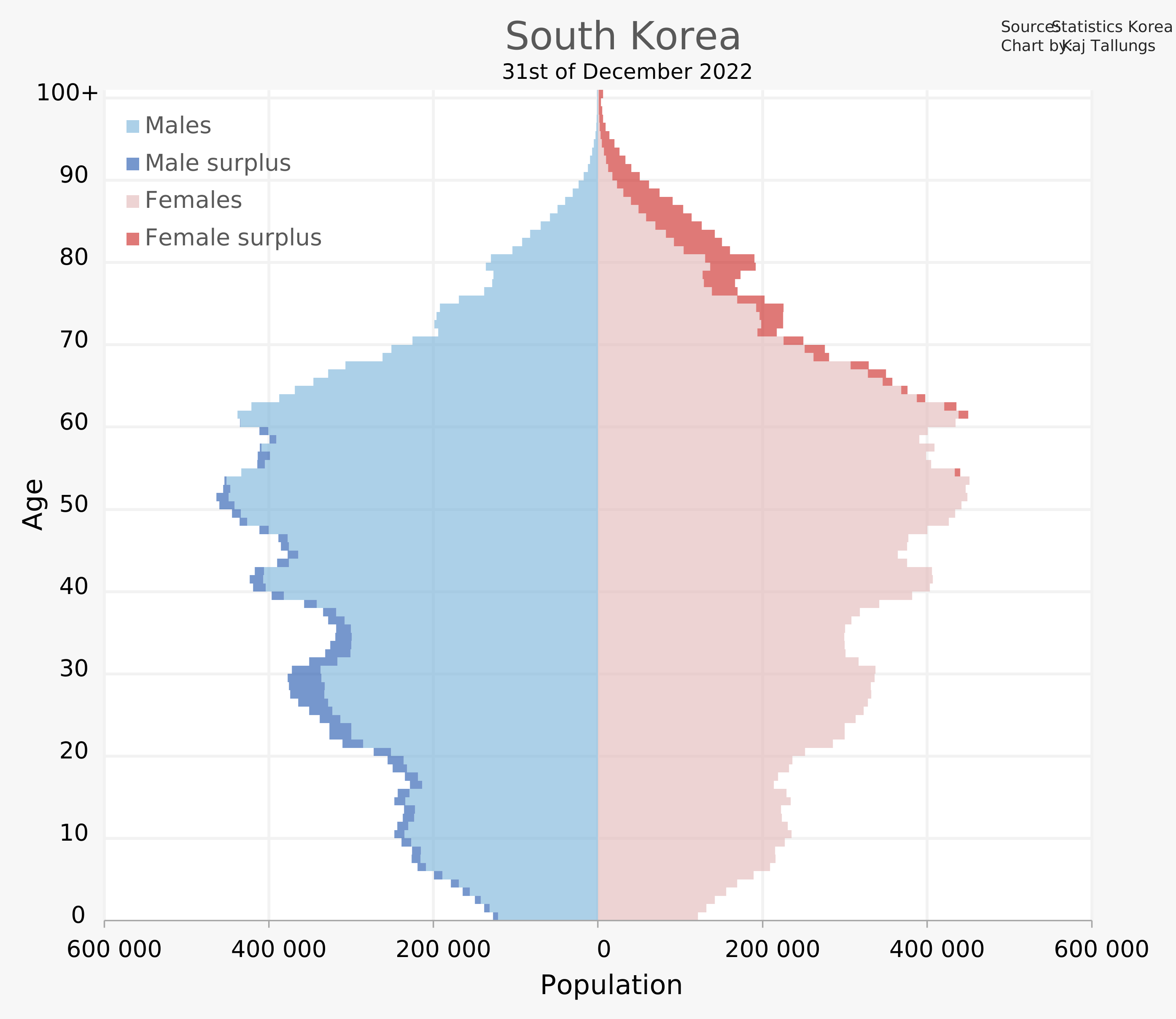
After the lump passes through South Koreans will look around and see a lack of traffic congestion, abundance of housing, lack of competitors for their now abundant resources, and lack of disproportionately large population of unproductive elderly dependents.
Wanna guess what happens in that welcoming environment? My guess is people feel inclined to make some babies.
I don't understand why people tend to treat these low fertility rates as some kind of invariable biological dysfunction. These aren't infertile masses of people; they're perfectly capable of multiplying like rabbits.
The planet has shitloads of people, maybe we're finally reeling things in from an overshoot and are on the inevitably pendulum-like path towards population stability. There's no reason to panic unless you've got substantial evidence these people are physically incapable of having children.
Edit:
How about some DATA: go to https://population.io, select Rep. of Korea, plug in some age/gender b.s. and scroll down to "Age Distribution" at the left column. Now look to the left of ~20yo (younger than 20), it's a nearly horizontal line. What does that tell you? There's a uniform rate of Korean babies per year under 20 years old. To the right of this, there's a massive lump of elderly people with a slightly smaller lump of middle-aged people. There's no reason to believe this horizontal line left of 20yo won't just continue into the future; it looks quite stable for the last ~20 years.