If your credit card is current. One of the "oh, this gets into trouble" is when you do a 10 year registration paid in advance and the credit card on file expires before the auto-renewal time.
The registrar will poke you, and put up warnings when you log into the server to check on your account that your auto renewal is coming up soon and the card on file has expired.
But if you're not paying attention to your domain registrations, or the renewal reminder emails get sent to the spam folder, or you've lost access to the original email address that you had to register it a decade ago, then godaddy is quite happy to put up a lander page with some inflated price on it and sell it to someone else.
> ... but how do you scale this up right 20 kow used to be enough to power a full rack of computer gear but we're seeing predictions now of 100 kilowatts per rack and that's just one rack in a data center racks right the 48U 19in rack which is you know big and it's just dense with computers how does that fit into a flat satellite well it turns out that like 19in rack is about 50 cm wide it's about 1 m deep per unit and if you've got a 24 1/2 square meter satellite and you take all your one U units and stack them ...
One rack per satellite doesn't seem like it is that compelling of a story.
Put a 100 kW rack in my basement in the winter and hook up the power and I'll be happy to deal with the waste heat for several months (and then ship it to somewhere in the southern hemisphere).
On the 8th, it was serving an error page from centos.
On the 9th, it was serving the new content. https://lookup.icann.org/en/lookup for zombo.com shows that it was updated on 2026-02-09 20:34:17 UTC
I believe that a more reasonable explanation would be that the domain name expired, someone saw that being the case, bought the domain name and hosted their own version of it.
I'm not sure that "stolen" is the proper verb to use, or that "hacker" is the appropriate attribution.
The current registration occurred in 1999. Typically, domain registrations are extended in yearly multiples, which can be seen by the fact that it expires on October 10th, the same day that it was registered.
If it expired in 2025, then that expiration would have occurred in October.
That said, you are probably correct that it wasn't a hacker as such. GoDaddy was indeed offering it for sale in February, according to a Reddit thread from that month[0]. That makes me wonder why...
That’s what the current page claims, legitimate registration by “New Management”.
> Welcome to… New Management. This domain was purchased openly via GoDaddy. We come in peace (and with a wallet): we’d love to also purchase the rights to the former site's content to help revive the infinite. Until then, everything here is new & unique. Old content rights owners, please reach out. Anything is possible.
> The first recorded uses of steganography can be traced back to 440 BC in Greece, when Herodotus mentions two examples in his Histories. Histiaeus sent a message to his vassal, Aristagoras, by shaving the head of his most trusted servant, "marking" the message onto his scalp, then sending him on his way once his hair had regrown, with the instruction, "When thou art come to Miletus, bid Aristagoras shave thy head, and look thereon." Additionally, Demaratus sent a warning about a forthcoming attack to Greece by writing it directly on the wooden backing of a wax tablet before applying its beeswax surface. Wax tablets were in common use then as reusable writing surfaces, sometimes used for shorthand.
Consider the rate of job hopping that would be evident on that resume. I'm not sure how many companies would be willing to invest in sending a FTE who stays somewhere for likely less than a year to a conference or say "Ok, you an spend 20% of your time improving your skills."
What is more likely with the 35 number is that these are multiple simultaneous contracts. When working as a contractor you're fixing that problem or that project. The company isn't going to have you around for longer than a month after it's been fixed and documented.
There's no reason to spend company resources on training a person any more than there's reason for you to pay a plumber to be reading "learn to be an electrician in 10 days" while they're supposed to be working on fixing the sink or doing the plumbing for new construction.
> Proto-Indo-European root meaning "to weave," also "to fabricate," especially with an ax, also "to make wicker or wattle fabric for (mud-covered) house walls."
> It might form all or part of: architect; context; dachshund; polytechnic; pretext; subtle; technical; techno-; technology; tectonic; tete; text; textile; tiller (n.1) "bar to turn the rudder of a boat;" tissue; toil (n.2) "net, snare."
> It might also be the source of: Sanskrit taksati "he fashions, constructs," taksan "carpenter;" Avestan taša "ax, hatchet," thwaxš- "be busy;" Old Persian taxš- "be active;" Latin texere "to weave, fabricate," tela "web, net, warp of a fabric;" Greek tekton "carpenter," tekhnē "art;" Old Church Slavonic tesla "ax, hatchet;" ...
According to William Dalrymple, India was once responsible for a third of the world's GDP, with the most advanced textile industry in the world before the East India Company dismantled it.
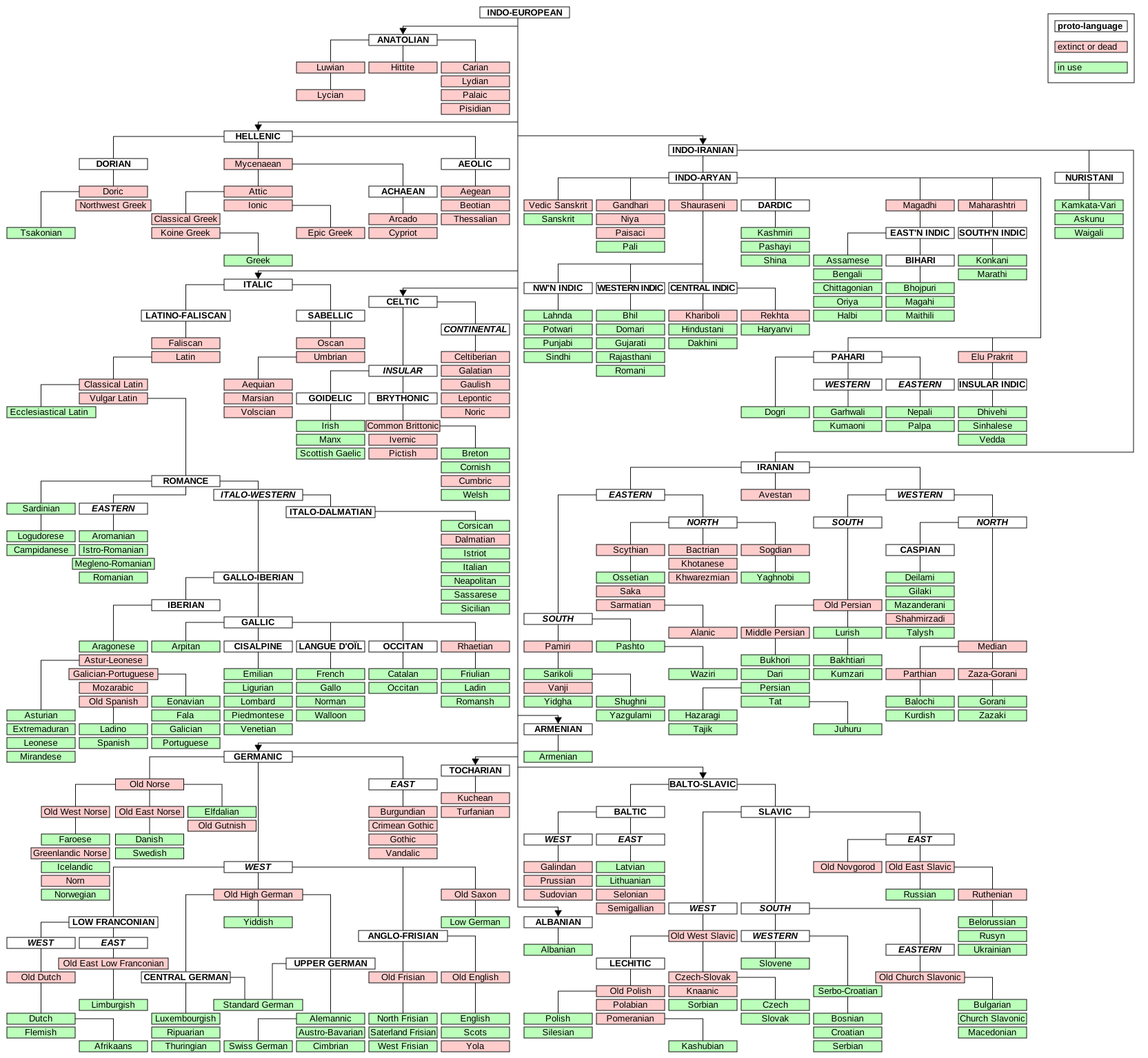
As a note, Sanskrit is a "sibling" or cousin of Latin or Greek in the family tree of languages ( https://upload.wikimedia.org/wikipedia/commons/4/4f/IndoEuro... ). Neither Latin nor Greek grew from Sanskrit but rather each (and many other languages) grew from Proto-Indo-European that was believed to exist somewhere in 4500 to 2500 BC.
As a novice in the history of languages and being k-lingual in a couple of Indian languages and English, the Farsi language is such a delightful stream of discoveries.
Regardless of which k of my languages I restrict myself to, I end up discovering words that are same between Farsi and that language.
I understand that this should not be surprising given their roots in Indo-Iranian languages, the largest branches of Indo-European.
Nonetheless it is delightful everytime I discover a new one by accident.
> But the manuscript that Otto Frank pitched to Dutch editors didn’t contain his daughter’s entire diary. Anne herself had begun editing large swathes of her diary with publication in mind after hearing a radio broadcast that called on Dutch people to preserve diaries and other war documents. Otto respected some of those editorial decisions, but overlooked others – for example, he included material about Anne’s crush on annexe dweller Peter van Pels.
> Frank’s candid words on sex didn’t make it into the first published diary, which appeared in English in 1952. Though Anne herself edited her diary with an eye to publication, the book—released eight years after her death from typhus in the Bergen-Belsen concentration camp at age 15—contained additional cuts. These were only partially restored in 1986, when a critical edition of her diary was published. Then, in 1995, an even less censored version, including a passage on Frank’s own body previously withheld by her father, was published.
> In response to Minister Bolkestein's appeal on 28 March 1944 on Radio Oranje to keep wartime diaries and letters, Anne Frank decided to rewrite her diary into a novel: "Imagine how interesting it would be if I published a novel of the Secret Annex, from the title alone people would think it was a detective novel."
> Anne rewrote and edited her diary on loose sheets of duplicator paper. On Saturday 20 May 1944, she wrote: "Dear Kitty, At last after much contemplation I have begun my 'the Secret Annex', in my head it is already as finished as it can be, but in reality it will be a lot slower, if it ever gets finished at all." Anne's rewritten version, known as Version B, ends with the diary entry of 29 March 1944.
Thank you, I remember reading this background as well.
There is no 'unedited' version of Anne's diary, as Anne herself intentionally edited and re-edited her work during her time in the Annex. A remarkable young woman. What was published to readers are various versions that have additionally been further somewhat edited by others and in places censored, with the trend being towards gradually less censorship over time.
Kurzgesagt typically does STEM focused videos... they've got a new channel "After Dark" which focuses on history and historical figures. Their first one: Kurzgesagt After Dark The Final Days of Louis XIV - https://youtu.be/bIwX4QuL90k?si=9WLbzKqxo08KCDum&t=564
> And though the operation was done in secret, a new fashion sweeps the court: Bandages wrapped around everyone’s buttocks.
> The qualities of American writing have clearly been on a precipitous decline for a very long time now, predating AI slop and even spell checkers and computers.
> Every NYT bestseller from 1960 to 2014 falls in the seventh-grade level spread, from 4th to 11th.
> ...
> Since 2000, only 2 bestsellers have scored higher than 9th-grade readability.
> ... ...
> The bestselling authors of our time are writing at the 4th-grade level.
> > “8 books tie for the lowest score,” a 4.4, just above 4th-grade level. Prolific, well-known authors with huge sales: James Patterson, Janet Evonvich, and Nora Roberts.”
> These three authors have written a combined total of 419 books.
Whenever I read something from roughly the first half of the 20th century (I'm not sure where the cutoff point is, it seems to the 1960s), I'm struck by the quality of the writing. I'm not sure what happened, but it's pretty clear that at some point we stopped taking ourselves seriously.
We see the same thing in how people dress. People used to write "respectably", and they used to dress the same, and in TV interviews they spoke with great care and deliberation.
> Well, for one example, it inhibits your desire to improve against those very blind spots.
I'd contend this is not true. Even professional authors go to an editor who identifies things that need to be fixed. As the author of the text and knowing what it should be, it can be difficult to read what you wrote to find those mistakes.
> In exchange for that your audience gets 3-4x length normalized bullshit to read instead.
This is not at all what is implied by having an AI act as an editor. Identifying misplaced commas, incorrect subject verb agreement (e.g. counts), and incomplete ideas left in as sentence fragments.
You appear to be implying that the author is giving agency to create the content to the AI rather than using it as a tool to act as a super-charged grammerly.
> Even professional authors go to an editor who identifies things that need to be fixed.
Yes, and these people are good at it. What’s your point?
If you need grammar checking, there are thousands of apps including word processors, web browsers and even most mobile devices that will check your inputs for grammar and spelling mistakes as you type. All of that without burning down the rainforests or neutering your thesis.
I believe you are confusing what an editor does and proofreading.
In the time before LLMs, for some of my occasional blog posts I'd first post it to whatever messaging system my colleges used and ask them to read over it. Identifying that "this word is confusing in this context" or "you're using jargon here that I'm unfamiliar with" is helpful. There's also stylistic items of "this sentence goes on for far too many words and thoughts without making a single punctuation mark indicating where it is complete or delineating two or more different ideas leading the reader to have to keep back tracking the thought to try to keep it all in their mind which can be confusing and makes it more difficult to read."
Proofreading tools pick up some typos and punctation errors in that previous bit. https://imgur.com/a/oqqoEGV None of them called out its structure.
The overly long example sentence introduces unintended humor or self-parody, which may dilute the seriousness of the point.
Now, one could argue that taking its advice for the structure and that I have incompletely formulated some arguments would change the tone of my writing. However, any changes that I make are changes that I intend to make and are not the result of the LLM rewriting my words.


The registrar will poke you, and put up warnings when you log into the server to check on your account that your auto renewal is coming up soon and the card on file has expired.
But if you're not paying attention to your domain registrations, or the renewal reminder emails get sent to the spam folder, or you've lost access to the original email address that you had to register it a decade ago, then godaddy is quite happy to put up a lander page with some inflated price on it and sell it to someone else.
reply