> What you should do instead is write all your code so it is little-endian only, as the only relevant big-endian architecture is s390x, and if someone wants to run your code on s390x, they can afford a support contract.
Or you can just be a nice person and make your code endian-agnostic. ;-)
France had to nationalize EDF due to the exorbitant cost of their nuclear fleet, and they cannot get a reactor built within reasonable capital costs. Spain plans to deprecate their remaining nuclear for renewables for similar reasons. California will achieve a low carbon generation profile for far cheaper than it cost France (refer to the Lazard LCOE data product I've cited in my other comment in this thread).
Spain’s Nuclear Shutdown Set to Test Renewables Success Story - https://www.bloomberg.com/news/articles/2025-04-11/spain-s-n... | https://archive.today/4fB7K - April 11th, 2025 (“Spain is a postcard, a glimpse into the future where you’re not going to need baseload generators from 8am to 5pm” with solar and wind providing all of the grid’s needs during that time, said Kesavarthiniy Savarimuthu, a European power markets analyst with BloombergNEF. Still, she said, there is a reasonable chance this goal may take longer than expected and “extending the life of the nuclear fleet can prove as an insurance for these delays.”) (My note: As of this comment, Spain has 7.12GW of nuclear generation capacity per ree.es, and assuming ~2GW/month deployment rate seen in Germany, could replace this capacity with solar and batteries in ~17 months; per Electricity Maps, only 15.45% of Spain's electrical generation over the last twelve months has been sourced from this nuclear: https://app.electricitymaps.com/map/zone/ES/12mo/monthly)
The reason EDF had to be nationalized is because the government used the company as a "price shield" to protect consumer against energy price rise on the European market in 2022 with a mechanism named TRV (Tarif Régulé vente). That digged up EDF dept tremendously.
> Spain plans to deprecate their remaining nuclear for renewables for similar reasons
Span deprecated their nuclear government because their current Socialist government is aligned with Ecologists that are, like everywhere in Europe, antinuclear.
Additionally, the lack of spinning generator in Spain is currently partially what caused the Blackout in Spain in 2025 due to a lack of inertia in the system.
> EDF fleet upkeep will cost over 100 billion euros by 2035, court of auditors says
This is over 25 years and will prolong-ate the lifetime of the 56 reactors by 20 more years. These produce 70% of the country need in electricity.
In comparison, the German energiewende cost 400 billions for 37% of electricity of 2025 produced by solar and wind. With production medium that will need to be entirely renewed in 20 years.
> California will achieve a low carbon generation profile for far cheaper than it cost France (refer to the Lazard LCOE
That is also wrong.
Because LCOE calculation does not take into consideration the price of the grid consolidating necessary for renewable nor the necessity of backup generation in case of dunkleflaute.
>> France had to nationalize EDF due to the exorbitant cost of their nuclear fleet
>That's just wrong.
No, it's correct, the total costs of the 2022 bailout was almost 10bn, and that was to get control over a company that had over 50bn in debt.
Furthermore it was discovered that the plants had neglected maintenance that had to be undertaken rightaway, that had nothing to do with the TRV.
Of course, the TRV didn't help, it caused a loss of 18bn in 2022 on top of everything else, but things were bad already.
So even if the mentioned 5 bn export now was pure profit - which is isn't - it would take 15-20 years to cover the bailout that has already taken place. The 100 billion of investments until 2035 is in addition to that.
And they will have to sell their power on markets that will increasingly often have free electricity from solar and wind. How do you pay 1000 educated plant operators when electricity prices are negative?
Unfortunately nuclear power isn't the kind of thing you can try and then walk away from when it turns out to be a bad idea. Which is likely the main reason it's still around.
> No, it's correct, the total costs of the 2022 bailout was almost 10bn, and that was to get control over a company that had over 50bn in debt.
Bailout of 2022 alone was around 22bn€, which was added on top of it the historical debt.
Revenue of EDF in 2025 is over 100bn€ to put things into perspective.
> Furthermore it was discovered that the plants had neglected maintenance that had to be undertaken rightaway, that had nothing to do with the TRV.
That is also wrong. The immediate maintenance in 2022 was related to "corrosion sous contrainte" which has nothing to do with carelessness. It was mainly the French nuclear regulator (ASN) over-reacting to some non-critical cracks find in some pipes. They have themselves said afterward that the immediate actions were not necessary. The actions were overreactive (from EDF side) and the calendar was very unfortunate.
> So even if the mentioned 5 bn export now was pure profit - which is isn't -
Indeed. Profits in 2025 were currently over 8bn€, so well over 5bn€.
5bn€ just concern the profit made by the exports.
This is not hard to understand: Making a profit by selling valuable nuclear energy during evening peak consumption while buying cheap intermittent solar during low consumption time is an easy game.
People generally do not understand that Nuclear is a CAPEX game, not an OPEX one.
> And they will have to sell their power on markets that will increasingly often have free electricity from solar and wind. How do you pay 1000 educated plant operators when electricity prices are negative?
By selling nuclear electricity at 180€/MWh every night when the sun do not shine.
(This is the average price, every evening peak this month)
Meaning-while, the profitability of solar operators will sink to the ground due to the overcapacity causing negative price during the day as soon as the sun shine. Many of them will die if not state subsidized with public money.
> nuclear power isn't the kind of thing you can try and then walk away from when it turns out to be a bad idea
It is currently the best low-carbon energy around.
And will continue to be for the next 2 decades.
The current Co2/kwh emission of France is 27g/kwh.
The comparison with country like Germany (397g/kwh) or state like California (190g/kwh) that spend >100Bn$ on renewable speak for itself.
I can safely bet that in 15y from now, the French grid will still be greener than the German one.
> making a profit by selling valuable nuclear energy
EDF adjusted economic debt at the beginning of 2026: €81.7 billion
After decades of massive help (nationalisations building it, monopoly, gift-loans, debt cancellation...
> the profitability of solar operators will sink to the ground due to the overcapacity causing negative price
Wait for storage (V2G...) and hydrogen to kick in.
> France
> Germany
France's transition to nuclear power began in 1963 and is now complete.
In other countries (Germany...), transitions to renewables began with the advent of their industrial versions, around 2005. The current context makes these transitions more challenging, and they are still underway.
Therefore, any comparison of their results, for example, greenhouse gas emissions, must be based not on snapshots (which currently favor France since its transition is complete), but on their progress: speed, costs, impacts, etc.
> decades of massive help (nationalisations building it, monopoly, gift-loans, debt cancellation...
I start seriously question your intellectual honesty here.
- For the last 2 decades, EDF was privatised and give back to the state an average of 2bn€ per year in dividende [1]. That is currently EDF giving to the state, not the opposite.
- The monopoly situation in France was ended in 2007. The loi NOME in 2010 even offred to the competitor of EDF an access to nuclear energy at fixed low price [2].
Worth to note that when the Energy crisis spiked in 2022, the same 'competitors' sent back their customers to EDF because they massively increased their price and did not want to follow the TRV.
> hydrogen to kick in.
Nobody sane of mind and reasonable take hydrogen and Power2Gas seriously in the energy sector: The law of physics simply play against it.
The general efficient is low (practically around 50%), the electrolizers strongly hate the spike style usage pattern necessary for a coupling with intermittent energy, and no installations of the required scale has even been tried.
The only reason this is still on the table is because it gives the gaz industry a reason to drain public subsidies and some hope to stay relevant.
> France's transition to nuclear power began in 1963 and is now complete.
Thats also wrong.
The Messner plan started in 1974 and France was other 55% of electricity production provided by Nuclear in 1985. It finishes with over 50 reactors in 15 years to cover up more than 70% of the electricity generated [3]
The cost of the plan Messmer was estimated at 100bn€ in 2012 money.
Germany started their energiewende in 2005 and 20 years later and 400Bn€ burned, they still do have a CO2/kwh intensity 4x higher than France in the 80s.
The results are so bad that Germany started to subsidies its own industry to protect them against electricity price increase [4]
The return on state capital endowments, ranging from 3% to 6%, represents a low real return, significantly lower than the theoretical rates of 8% or 9% (excluding inflation) projected at the time by the General Planning Commission for public enterprises (page 33). Handouts!
The payment of meager dividends is sometimes cancelled or postponed (2015, 2016, 2017, 2019: https://www.latribune.fr/economie/france/edf-l-etat-va-renon... ), or partially made in the form of EDF shares ("in securities", for example between 2016 and 2022) therefore in monkey money because it does not replenish the public coffers at the time or later: EDF is very indebted and the bulk of its assets (nuclear power plants) are unsellable.
> loi NOME in 2010 even offred to the competitor of EDF an access to nuclear energy at fixed low price
'Low'? Nope. It happened in 2012 and this price was set at €42/MWh
The total production cost of a MWh in 2010 was €22 (see the French Court of Auditors' report "The Costs of the Nuclear Power Sector," page 81). Since the existing generation fleet is considered fully depreciated, the €20 difference covers the extension of its operating life (Grand Carénage) and the renewal/expansion of the new nuclear power plants (EPR series).
Nope: hydrogen vehicles are easy to criticize because the mass and size of the tank are prohibitive, and compression significantly increases the cost.
This leads some to condemn all forms of hydrogen use. However, in the case of backup power, not having to store it in a small mobile tank or even transport it, and therefore being able to store it in a stationary industrial tank (where mass and volume are relatively unimportant), is not only possible but already being achieved (record: Air Liquide, and the competition is intensifying) and, incidentally, improves efficiency.
Efficiency:
- Electrolysis (PEM or alkaline): 0.75
- Storage: 0.95
- Conventional combined cycle turbine (gas + steam) with efficiency similar to that achieved with natural gas: 0.6
Overall: approximately 0.4 (just like a very recent nuclear reactor, and without any waste-producing fuel...)
> electrolizers strongly hate the spike style usage pattern necessary for a coupling with intermittent energy
See PEM.
> no installations of the required scale has even been tried
Indeed, however all components are ready.
> France's transition to nuclear power began in 1963 and is now complete.
> The cost of the plan Messmer was estimated at 100bn€ in 2012 money.
This is the sole building cost. R&D is estimated at 55 billions (1945-2010) and the Court wrote that it is very difficult to assess, (page 35, footnote) "the scope of analysis does not cover research expenditures in the military field, nor those related to basic research.".
>This is not hard to understand: Making a profit by selling valuable nuclear energy during evening peak consumption while buying cheap intermittent solar during low consumption time is an easy game.
It is also easy to understand that the nuclear plant costs money even as you are buying cheap solar, because you can't just shut them down. This is a problem already, and we already have solar plants that generate energy 24/7.
They are small, sure but many, and the number is increasing very fast.
There is also tech in the pipeline that will accelerate this. Very cheap batteries among them.
Technology is already being deployed that will have electricity trend towards being free or almost free, 24/7. Pretty soon value will not be generated by selling electricity, instead you will have to generate value from consuming almost free electricity.
When does a nuclear plant generate profits then? They will inevitably have to close, and unfortunately for France, nuclear plants cost money even after they have closed.
This is complete baloney and revisionist history. I followed that topic at the time pretty in depth. It took months and months and delay upon delay to get the plants back up and running. The spot prices in France at times in 2022 went over 1500 euros per MWh. If it was just "an overreaction" there would've been tremendous political pressure to just put the plants back online. The government and EDF are intertwined to the point any talk of new construction etc. always goes through Macron.
> I followed that topic at the time pretty in depth
You apparently did not. because you are the revisionnist here.
CSC (corrosion sous contrainte) is a well documented topic with accessible reports from the ASN (the french nuclear agency) [1], the court des comptes (French accounting court) and EDF itself.
The source of the problem is a phenomena that affect mainly the N4 (1400MW) series of the French reactor. It has been detected in 2021, so before the 2022.
Some pipe in some specific part of the circuit (secondary circuit) presented some unexpected cracks under inspection in one specific reactor.
And EDF chose the stop all the potentially affected reactor and disassembly all the potentially affected pipe to scan them with X ray and triple check that the corrosion phenomena is not widespread.
Where they over-reacted, is that they also disassembled the different serie 900Mw reactor 'just in case', at the worst time.... meaning right before Vladmir Putin attacked Ukrain.
> If it was just "an overreaction" there would've been tremendous political pressure to just put the plants back online
Sure. They should have just emergency duck tape the pipe without following any safety protocol, in a nuclear installation, just to please some politicians and because Putin dreamed of cold war again #sarcasm.
You seem to have very little clue of about the nuclear industry internals and its associated safety processes.... It of course took time.
The only thing you are correct on is that, indeed, it took longer than expected and caused delays.
You said the problems were overblown, not me. I don't think they were overblown, so I am not sure you should be lecturing me on duct tape and nuclear plants. The EDF had scheduled a quarter of the fleet for maintenance and then at the peak of the crisis pulled another quarter offline unplanned. This simply wouldn't have happened if it hadn't been necessary, the government wouldn't have allowed it at the time. The problem was not known in 2021, but at the time when they were built. Here is an interview from 1979 (!) with the president of the EDF at the time Marcel Boiteux, who said that this will happen, but it's not a big deal because it will happen after the plants had reached their EOL in 30 years [1]. Additionally there was a government commission or something like that in the early 2010s that basically concluded "we can't afford to build new ones, let's kick the can down the road and try to fix what we have now". And then 10 years later the biggest energy crisis since the 70s comes along, the very reason they were built and you end up relying on the weather forecast and German coal plants. A few years pass again and some people are talking themselves again into this technology being anything except useless.
> with the president of the EDF at the time Marcel Boiteux, who said that this will happen, but it's not a big deal because it will happen after the plants had reached their EOL in 30 years.
That's not what he said. He said this is the scenario in case of full cycle up and down every day. Which is obviously not how a central is operated.
Consensus today is that nuclear powerplant can live for around 60-80y without issues if the maintenance is done properly.
The US park is getting there.
> This simply wouldn't have happened if it hadn't been necessary, the government wouldn't have allowed it at the time.
The government has no word to say over an ASN decision, specially when Nuclear safety is at stake.
It is France we are talking about, not the USSR.
Again, it is commonly admitted today, after the facts, that it was over-reacting. Thats said: It is bad economically as it cost EDF few billions. But it is exactly what you want to see for safety: Better overreacting than having an incident.
> A few years pass again and some people are talking themselves again into this technology being anything except useless.
So. You are taking one single year failure as a representative example of a technology that has given cheap, abundant and low carbon electricity for the entire Europeean continent for 3 decades ?
Do you have not the impression of being of slightly bad faith here ?
You can pretend to be meticulous about it but the president of the EDF doesn't go on TV to speak to the general public to say 30 years if he meant something else. He would've said 80 years because it just sounds better. Sorry, it's pretty obvious that stress corrosion was a known issue, so there were no surprises.
It's France, not USSR. Is this why the EDF was involved in rescuing Areva from bankruptcy -- a sound business decision? Is this why the government is giving basically interest free loans to the EDF that will be repaid starting from maybe in 15 years? If you really believe that you are delusional. It's all just backroom wheeling and dealing. There is a good saying "don't get high on your own supply". The delusion of order in the western world will be its end, especially now considering it's crumbling before our eyes. Clinging to this idea is not healthy.
Abundant and low carbon, all nice things, but it's not why they were built. They were built for energy independence, and at this task it failed at the exact point in time when it was supposed to shine. Speaking of which, being built for one purpose doesn't necessarily make it useful for another purpose. It was built at a time when things like carbon emissions, climate change and overall sustainability were not a topic. Since sustainability is a topic today, it requires obviously different considerations. My only gripe with the German shutdown is that they didn't force the operators to pay for the decommissioning and waste disposal in full. That would've ended any debate about how realistic and useful this technology is because the companies would've been insolvent.
The cost of the energy transition in Germany is sometimes cited as €300 billion, €500 billion, or even €1.5 trillion.
These figures are worthless because no reputable source publishes a specific figure along with the scope of the project (some aspects of the investments needed for the electricity grid are independent of the energy source) and at least a timeframe.
These figures are actually projections published by various sources, covering distant deadlines (2050, etc.) and the entire electricity system, including non-renewable energy sources (whose additional costs are often overestimated).
> EDF nuclear fleet is highly profitable with around 92TWh exported in 2025
Nope. Electricity exports are officially exported at a loss, since the average price per MWh exported is generally slightly lower than the average French spot price ( https://assets.rte-france.com/prod/public/2025-04/2025-04-09... , page 87). According to the sound approach established by Mr. Boiteux, this price must compensate for production costs as well as investments.
The average market price is decreasing because the renewable energy sector is expanding across the continent, thus supplying more and more electricity at a production cost that is increasingly lower than that of nuclear power.
According to RTE, France will export 92.3 TWh in 2025 (page 75), paid €5.4 billion (page 15), meaning that the average price per MWh will be €58.7. However, this renewable energy sector (considered fully amortized) will produce electricity at a cost of €60.3 according to the CRE (which considers it fully amortized and therefore neglects the bulk of the investment), and at around €78 according to EDF ( https://www.edf.fr/sites/groupe/files/epresspack/6300/CP_Con... ), which wants to build EPR2 reactors and therefore needs to have the necessary funds.
In short, France is exporting at €58.70 a year when it needs to sell for at least €78 to finance its future reactors, thus "using up" its current fleet without setting aside enough money to replace it.
Worse still: if the costs of the EPR2 reactors exceed forecasts, as all EPR construction projects (Finland, France, China, and the UK) have done, the deficit will increase even further.
Fixed costs (investments, maintenance, depreciation of the EPR alone, etc.) are by definition paid whether the fleet produces or not. Therefore, exporting at a price higher than the variable costs (paid only if the plant produces) is a lesser evil because the difference covers a portion of the fixed costs: it is less expensive to export at a slight loss than not to produce and lose more (in technical terms: the gross margin helps cover fixed costs).
However, claiming that nuclear power is profitable simply because of electricity exports is misleading, and the ideal solution would be to produce electricity at the lowest possible cost, therefore using renewable energy sources.
Furthermore, a portion of France's electricity is generated from renewables, so attributing exports solely to nuclear power is misleading.
> True but having capacity allows for generation - doesn't work the other way around.
The issue is that comparing "capacity" as a percentage is misleading. A baseload generation source can have average generation above 90% of its rated capacity, solar at something like 25%, wind something like 25-40%. Which means that saying "nearly 50%" of capacity can imply something closer to 15% of generation, and potentially even less if the amount of local capacity is high, because then you get periods when renewable generation exceeds demand and the additional generation has nowhere to go, which effectively reduces the capacity factor even more.
And on the other side, natural gas peaker plants can have a capacity factor even lower than solar and wind because their explicit purpose is to only be used when demand exceeds supply from other sources, so that "nearly 50%" in a grid which is entirely renewables and peaker plants could actually imply more than 50% of total generation. This is much less common in existing grids but it makes looking at the nameplate capacity even more worthless because you can't just multiply it by a fixed factor to get the real number.
Whereas if they would just publish the percentage of actual generation, that's what people actually want to know. But then you'd have to say "13%" or "24%" or whatever the real number is, instead of "nearly 50%".
The graph at https://ourworldindata.org/grapher/solar-pv-energy-consumpti... seems to indicate the real world outcome is something more like 12.9%. That is, pick a dot on the graph and look at the capacity (watts) versus how much was generated in 2024 (watt-hours), and the number ends up vaguely looking like 1000 watt-hours generated for every watt of capacity. Given that there's 8760 hours in a year, that's vaguely in the 12% range.
The number for "World" is 2,110,000 GWh consumed for 1,866 GW of capacity, which means 2110000÷(1866×8760) = 12.9% of "capacity". Running the numbers for every country (there's a csv!) shows expected cloudy/northerly countries down near 8-9% (UK, germany, norway) and the sunnier ones near 20%... The USA is 19.8% which tracks given how popular solar is in the sunnier regions in particular.
Nobody in their right mind should be surprised by this, since the sun doesn't always shine, it gets dark at night, etc... it's unrealistic to assume this number will ever meaningfully change for solar. It's just the baseline expectation.
So yeah, "capacity" is misleading indeed. It means that for solar, "50% of global capacity" would mean something more like "6% of energy consumed".
But it's still super exciting to see the clear exponential growth here. (Speaking as someone who installed a 14KW array on his roof last year, solar makes me super excited.)
Rooftop is presumably bringing down the US average, maybe there is more rooftop capacity in the north and utility-scale capacity in the southwest or utility-scale more often uses sun tracking. And as you point out solar output is quite dependent on latitude and clear skies.
> it's unrealistic to assume this number will ever meaningfully change for solar.
Well, sort of. Being dependent on all of those things means it would change depending on where the capacity is being installed and what kind. The world average is ~13% primarily because China + Europe represents around two thirds of current capacity and China has a shockingly poor capacity factor for its latitude whereas Europe has the expectedly poor capacity factor for its latitude -- how did China manage to get a lower capacity factor than Finland or Russia anyway?
But go install a lot more utility-scale capacity in the US Southwest, India, Australia, South America, etc. and the world average would move up by a non-trivial amount.
The point is that its a proxy for more renewables being deployed on the grid. Thats the take away. It is a piece of good news. From one fellow energy nerd to likely another one - don't get hung up on the details. There is still a lot of work left to do.
I'm too lazy to double check the numbers, but as far as I remember, Germany in order to increase it's average generation by 10% had to expand capacity by 70% in solar plus wind. With stats like this, there's a thin line between progress and waste. And all this while we have nuclear.
(How the world really works, Vaclav smil if anybody is less lazy than me)
No, capacity factor is a distraction. The only meaningful question is whether it is cost effective or not compared to other production methods,, and solar - taking into account the low capacity factor - is starting to look very good.
I would say as electrician in Bavaria: there are enough empty roofs for solar. Especially in poorer neighborhoods. I saw similar numbers and they are scary: to reliably replace conventional power plant one needs 20x the power of wind and solar. And this hardware must be imported from China, there is no large scale production of solar equipment in Europe.
A lot of renewables have intermittent generation. If daytime electricity demand is already saturated, adding more solar panels increases capacity but doesn't increase generation (or to be more specific, it doesn't increase generation that actually fulfills demand).
We can also time shift many of the things we do. Does your fridge need to run between 3-5pm in the heat of summer? or can it make sure its a little cooler to avoid running then? (trivial example, probably not a good one)
I'm sure there are better examples, but your fridge idea doesn't work. Fridges already operate on the edge of freezing, so if you make it a little cooler you will ruin all your food. Also 3-5pm is peak hangry time.
This is why a major part of the solution is electric vehicles. Why put batteries in a warehouse and then run vehicles on petroleum when you can put batteries in a vehicle, install twice as many renewables because you now have more demand for electricity, and then charge the vehicles when generation is a large percentage of rated capacity and still have enough to run the rest of the grid when it's a smaller percentage?
It will be a mix. There is certainly still a lot which can be done on the demand side, e.g. when to cool a cool storage house during the day, or when to run certain production lines.
This is correct in the sense that, if you were to build a zero emissions energy system from scratch with today's technology, your conclusion would be that you'd eventually have to do this.
But in much of the world, setting up PV is economically sound simply because it displaces a certain amount of kWh generated over the course of a year from other sources that are more polluting and more expensive.
In this regime, the dynamics of production over time don't matter yet.
At some point, when renewable generation has very high penetration, you'll reach a point where building more is uneconomical, and to then displace the remaining other power sources you'll need to overpay (ignoring externalities).
However, that's assuming no technological change on the way there, which is a whole separate topic.
So massively overprovision them. It’s still cheaper than fossil fuels, especially if you price in all the externalities. Seems like all these hungry datacenters we’re building can soak up any excess capacity anyway.
What does cheap mean? You aren't paying for the same thing - a ccgt plant is super fast and works independent of the weather.
I'm in favour of having it but the reason why you need to over provision is because of the intermittency. This can also push out proper base load (e.g. nuclear) although it's not simple.
You have to think about the portfolio.
In Britain at least there is also a bit of a sleight of hand where the marginal costs are reported but not the CFD strike prices used to incentivise the buildout.
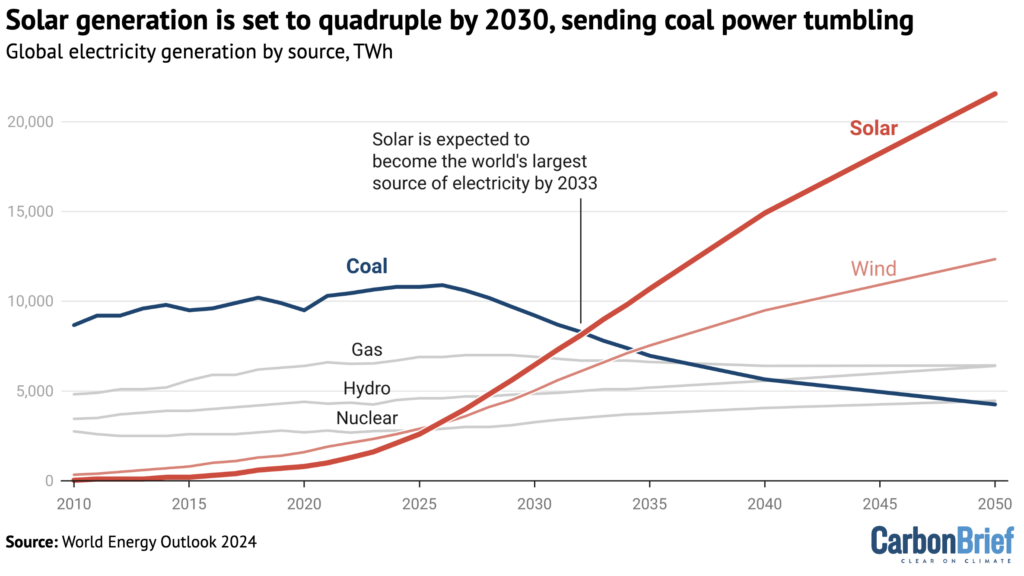
Clean generation is probably going to be 44% for 2025, up from 41% in 2024.
That's nuclear, hydro, wind and solar.
A glance at any chart showing that broken down reveals the solar and wind part to be growing at a surprising rate and the main hope for the future. There's no real limit to its growth leading to graphs like this:
> Great, so basically the tax payer is subsidizing your energy consumption.
> Sounds like a fair system.
Yes, people voted for tax credits for solar/renewables. It is a fair system. You know what isn't a fair system? Fossil fuel externalities causing childhood asthma and rising sea levels requiring rebuilding coastal infrastructure globally.
Tax payer is funding a lot of resilience stuff. At least in places where resilience exists at all. GP is where emergency services will charge their radios once their generator fuel runs out. Or whoever the local community improvises as substitute to emergency services, if there aren't any. As a tax payer who doesn't have the opportunity to do anything like that I really don't mind subsidizing.
Yet the market still thinks differently. Lots of countries still keep subsidizing EV despite them already being mature technology for such a long time.
We didn't have to subsidize the smart phone to make it successful, we shouldn't have to subsidize electric cars either.
Maybe if we had smartphones that emitted greenhouse and toxic gases by using a mini ICE engine that were so cheap nobody would buy anything else, we would subsidize the electric ones. We may even ban the gas phones.
I am not comparing BEV with ICE. That would be stupid. ICE is not and will never be a solution to the fact that we are burning oil and destroying the environment. But EV has to compete with ICE and many people don't like the fact that they might be a small inconvenience. The environment is just not part of the calculation so to make BEVs even slightly competitive the price has to be lowered.
H2 doesn't compete with ICE. It competes with BEV. That and in that comparison I do think it is much simpler. I'd be open to be enlightened why the killer feature of H2 is that makes it even worth considering with all these downsides.
> we shouldn't have to subsidize electric cars either.
Smart phones were subsidised, just less obviously. Much of the fundamental research into the radio systems was done by government labs, for example.
Not to mention that governments provide maaaaasssive subsidies to the entire fossil fuel industry, including multi-trillion dollar wars in the middle east to control the oil!
Look at it from the perspective of pollution control in cities. China just invested tens of billions - maybe hundreds — into clearing out the smog they were notorious for. Electric vehicles are a part of the solution.
The alternative is everyone living a decade less because… the market forces will it.
According to the Wikipedia article, it is still significantly worse than Just Using the Electricity (~21 to 48% efficiency just on the hydrogen production part, not counting distribution and consumption).
> As always with Zig posts, here come the haters. I really wonder why you even care about it.
It's another language stack that would need to be maintained within Linux distributions for years to come (security support, architecture support etc).
Upstream developers always seem to assume that there is no cost associated to introducing new software stacks. But in the end, someone has to maintain it. And they keep forgetting the purpose of software is to serve users, not developers.
And I'm not sure what's so revolutionary about Zig that couldn't have been solved by improving other languages.
For Zig in particular, the language isn't even stable enough that you can compile packages like Ghostty with any recent version of the Zig compiler. It has to be a very specific version of the compiler.
No. If you don't want to maintain it, don't package it, or for that matter programs written in it. Yes, there are valid reasons not to use zig from a stability perspective, but just ignore it if it isn't good enough for your standards.
Personally I'm glad that there are more people trying to break out of the C tar pit. Even if I'd never chose to use the language.
> And they keep forgetting the purpose of software is to serve users, not developers.
I don't have any horse in the game, but I do think Zig is interesting. This remark is funny to me because it's literally one of the tenets the Zig devs make decisions by!


Or you can just be a nice person and make your code endian-agnostic. ;-)
reply