If you are unsure of bhyve's abilities then why not test yourself? Speculation and guessing about stability or testing is useless without seeing if it works in your application.
> If you are unsure of bhyve's abilities then why not test yourself?
It is not possible to come to a conclusion about everything in the world yourself "from scratch". No one has the time to try out everything themselves. Some filteration process needs to be applied to prevent wasting your finite time.
That is why you ask for recommendations of hotels, restaurants, travel destinations, good computer brands, software and so on from friends, relatives or other trusted parties/groups. This does not mean your don't form your opinions. You use the opinions of others as a sort of bootstrap or prior which you can always refine.
HN is actually the perfect place to ask for opinions. Someone just said bhyve does not support nested virtualization (useful input !). Someone else might chime in and say they have run bhyve for a long time and they trust it (and so on...)
I agree with you and do not understand the “I read every manual” and “I test all software” crowd. I play around with A LOT of software but I cannot test it all.
Speculation is not useless if you are saying “the answer I got makes it 99% likely that this solution will not work for me”. Curation has immense value in the world today. I investigate only the options most likely to be useful. And that still takes all my time.
The phrasing of your questions is the problem. They are uninformed, too general, and assuming. The last sentence reads as if you outright dismiss bhyve because YOU can't imagine it was tested thoroughly.
> It is not possible to come to a conclusion about everything in the world yourself "from scratch". No one has the time to try out everything themselves. Some filteration process needs to be applied to prevent wasting your finite time.
It's totally possible when you know what your application requires but you didn't state anything.
> Someone just said bhyve does not support nested virtualization (useful input !).
Ok you have a problem with the way I framed my questions and my (unintentional) tonality. Fair enough. Let's move from critique of the way I asked my questions to what your experience with bhyve has been, if you're willing to share that.
Have you used bhyve ? What has your experience been with it ? Have you used KVM+QEMU -- can you compare your experience between both of them ?
> Map books were no fun but some of the dudes I worked with definitely became route-finding savants.
Similar. I worked doing deliveries for an event company all over the greater NY area, based out of Queens. I usually rode jump-seat and spent a few years with a retired trucker who was such a savant. He could maneuver a truck through any tight/precarious situation with great precision and care. He could visit a location once and recall it next year, every year.
The most impressive was a full day gauntlet starting at 5 AM where he navigated starting in south queens NYC to a stop in Staten Island, then off to Jersey city, then up to Sleepy Hollow NY, then all the way to some Greek church deep in Suffolk county through the winding maze that is the north shore - no map, no gps.
The most scary situation was driving a smaller Isuzu cab-over box truck through Brooklyn on a hot summer day. We had no AC, windows down, headed along a narrow avenue under the elevated train tracks. A passing truck was a little too far - BOOM- a loud shattering glass and bang sound. Turns out that idiot hit his mirror violently into ours so hard it showered him directly in the face with shards of mirror. I only got hit with a few pieces in the arm and a bunch landed on my lap. He didn't flinch. He kept the truck strait while muttering "I've been waiting for that to happen again." He thankfully only had two small cuts on his face, nothing went into his eyes. We lucky passed an auto parts store and he was able to rig up something on the mirror bar, continued on and finished the route.
He was a real character and he always had a lot of fun and crazy road stories. That dude also taught me to drive a truck with air brakes which is also how I learned to drive a manual. In addition to showing me all the secret traffic avoidance and toll beating routes, he was a foodie and showed me a lot of interesting restaurants he'd stop at along our routes. He took me to the famous Wo Hop in Manhttan's China Town when you could just walk in and get a table (late 90's.) He parked the truck at an inactive construction site a block away and moved cones around it so we didn't get a ticket. That character knew all the tricks :-)
> Do you drive an automatic car? Do you use a microwave? Do you buy food from a grocery store? Do you own power tools?
None of these things allow you to turn your brain off while the machine does the work.
I still have to DRIVE the car and all the thinking that goes with that. It's not a robotaxi.
I still have to acquire and prep the food I am microwaving. It's not a replicator.
I still have to know what I want to eat before grocery shopping and prepare the food. It's not a take out restaurant.
I still have to know how to use the power tools to carefully shape something into a fine piece of furniture and not a pile of splintered firewood. Power tools can't operate on their own unless aliens (see Maximum Overdrive.)
These are better analogies:
Do you take a taxi or public transport? Those let you turn your brain off while someone or something does the driving work.
Do you go to a restaurant where you can pick what you want, turn your brain off and wait for a delicious (or not) meal?
Do you order takeout where you can order what you want form the comfort of your home, turn your brain off and enjoy the meal when it arrives? Then reheat the leftovers in the microwave.
Do you use a fabrication service where you send them a drawing, turn your brain off, and they ship you an assembled thing?
All of your examples involve you sitting and waiting. That doesn't seem like an apt analogy for what AI can do. You don't have to sit there and come up with other things to do while the AI does the work.
When AI works (and technology in general) that's kind of what it's like. You'll never perceive that you are not doing the work anymore because you won't perceive the work.
> All of your examples involve you sitting and waiting. That doesn't seem like an apt analogy for what AI can do.
I just read a blog post or comment (honestly cant keep track of all this AI hype) about someone who literally did just that. They told and AI to build an app then went out and painted their fence or something, came back and had an app.
This is what people want from AI. They want take-out software.
Seriously. This desk does the opposite of what I need. My cat has no issue getting on top of the desk. I need the desk to keep the cat off the keyboard and a shield over my mousing area before the cat settles it and denies mouse access.
Yea sure. Whatever. Keep telling people they're useless without a computer crutch.
It's a shame people like Chris Gambill think they need AI to stay relevant. Makes me glad I don't have to fool myself into feeling good about my oppressive job.
This past summer I tried to forgo AC. It lasted until the dog days of July/August where the humidity was so high that it made me lethargic. I gave up and setup my AC in the window.
Then I traveled to Spain in August and was hosted at someones house for a week. They had no AC. And their method is simple: split the day in two resulting in the siesta. During the day in the intense heat you're tired by 3 PM and nearly dead by 5. The Spaniards? They go home and go to sleep for an hour or two then wake up when the sun has gone down and it cools down. Most things close at 5PM and reopen around 8PM. People stay out late too - I saw parents chatting on benches at a playground after midnight while their children played.
We have ways around this heat problem. Though I know people so spoiled that they INSIST their home and workspace must be at 60F even in 100F heat. They'll burn forests just so they wont be inconvenienced by a bead of sweat.
I don't consider that being uncomfortable is a solution.
There are actual solutions used by hot countries to deal with the heat: ventilation, vegetation, construction techniques, etc... But adjusting work schedules so that you have a hour or two of poor quality sleep when you can't do anything else is the kind of thing you do when you have no other choice, not a solution.
I have nothing against the Spanish schedule, but I would rather not do my siesta in an unbearably hot place. And yes, AC is a solution.
AC doesn't have to be that bad. Set a reasonable temperature, combine it with good insulation, etc... Same idea as for heating in the winter.
The siesta is a part of the solution to being uncomfortable. Rather it works with the nature of the earth and human biology, instead of using brute force to work against it. It is a different solution to the same problem.
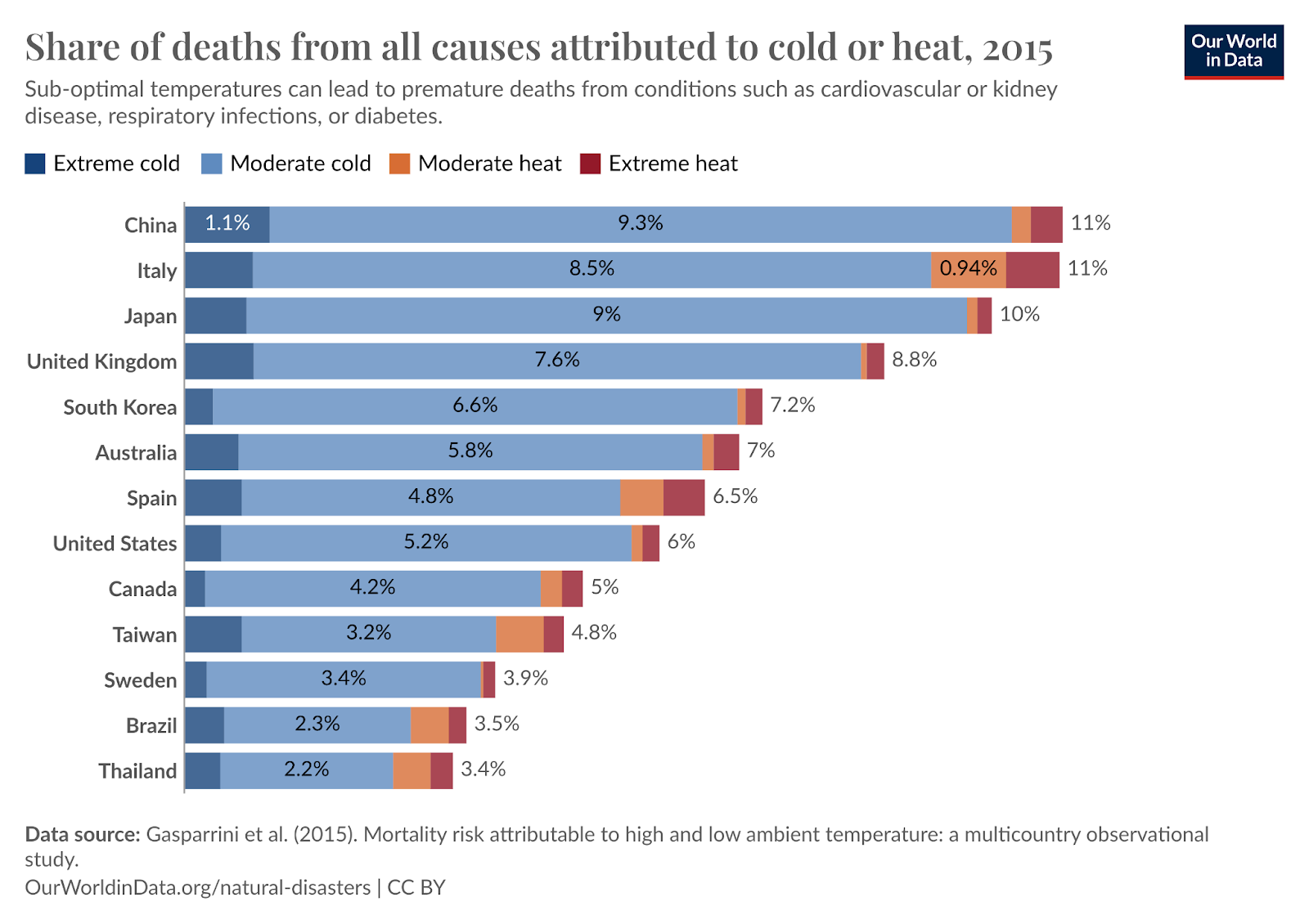
A study from 2023 estimated a worst case blackout in Phoenix AZ could approach 1% fatality. Considering power demand would be at its highest during a heat wave, the odds of this worst case scenario are quite high.
"In Phoenix, where the lowest daily high temperature over the 5 day heat wave is 43 °C and daily minimum temperatures average 32 °C, the rate of heat-related mortality increases by about 700% relative to the Power On scenario, reflecting the extremity of heat exposures in a desert city in the absence of mechanical AC. As reported in Figure 3, the estimated rate of heat-related mortality for the Power Off scenario in Phoenix is 917 (approximate total =13,250 deaths), which approaches 1% of the synthetic population."
"The Office of Resiliency received a termination notice from the U.S. Environmental Protection Agency regarding the Solar for All grant on August 7, 2025. The program is unavailable until further notice."
Or they can wait for the worst case scenario to actually happen, and THEN do something, as is tradition.
What did people in Phoenix do before modern heat pump air conditioning existed? Plenty of people live in hot arid places on earth. Humans have figured out passive air conditioning since prehistory: https://en.wikipedia.org/wiki/Air_conditioning#History
The problem with cities like Phoenix that is people are used to high levels comfort while building traditional structures in the middle of a desert. To cope, electricity hungry industrialized HVAC systems fight the desert weather. With a daily hot/cool cycle and modern thermal management you'd think the "passive house" would be law there by now.
Yeah; loss of utility heat in the wither has a much higher fatality risk, I'd think. The difference is, many homes have multiple heating methods available to them. If the natural gas is out, use an electric spaceheater, for example. Some homes use electric heat, others natural gas, others heating oil (which is a distributed solution.. or at least, involves a caching layer!)
Many homes have fireplaces or wood-burning stoves, again, for backup.
If you are doing it for the environment, you should forgo heat. 100F to 70F is only a 30 degree delta. If you have a heat pump, this is the same amount of energy heating your home to 70F from 40F. If you have natural gas heating, now we are talking about the same amount of energy when it is low 50's outside.
How many forests will you burn to not just wear two sweaters and blanket?
There are cultures around the world that pull this off very broadly. It takes a different attitude towards work and human wellness than what we have in the US
I live in Europe, not the US, where 9-5 (more like 8-5) is common. Not everything revolves around the US you know, we are allowed to have and talk about our own issues too. And US is on the winning side here because residential AC use is more normalized there instead of accepting people will have to die from heat strokes just to "save the environment" like it is in some EU countries. 15K to 19K people died from heat strokes in summer of 2003 France. In 2022 about 10k died from heat strokes. Not great in my book when we're talking about a rich western country that has the technology and the money to prevent such deaths, but we choose not to out of environmental and regulatory idealist Martyrdom.
And I'm sure my current country of Austria won't adopt Spanish way of work and life anytime soon just because summers are hot an people don't have AC at home/work. Societies, especially the Austrian one, are incredibly stubborn to change for a variety of reasons even when the evidence and solution is right in front of you. How do I know this? Well, Covid proved we can do a lot of work from home. Did that stick? Of course not, we still have to go to the office for most white collar jobs, even IT ones, just because management said so. We don't live in a world run by proof and rationale, we live in a world run by the status quo, vibes and feelings of the boomer and asset owning class.
His also omits CRC, which is part of the 25k lines, no --fast/--best/etc, missing some output formats, and so on. I'm sure the 25k includes a lot of bloat, but the comparison is odd. Comparing to your list would make much more sense.
I would expect a CRC to add a negligible number of lines of code. The reason that production-grade decompressors are tens of thousands of LOC is likely attributable to extreme manual optimization. For example, I wouldn't be surprised if a measurable fraction of those lines are actually inline assembly.
That's java code, though... bit weird, esp. i % 8 (which is just i & 7). The compiler should be able to optimize it since 'i' is guaranteed to be non-negative, still awkward.
Java CRC32 nowadays uses intrinsics and avx128 for crc32.
Doesn't need to be inline assembly, just pre-encoded lookup tables and intrinsics-based vectorized CRC alone will add quite a lot of code. Most multi-platform CRC algorithms tend to have at least a few paths for byte/word/dword at a time, hardware CRC, and hardware GF(2) multiply. It's not really extreme optimization, just better algorithms to match better hardware capabilities.
The Huffman decoding implementation is also bigger in production implementations for both speed and error checking. Two Huffman trees need to be exactly complete except in the special case of a single code, and in most cases they are flattened to two-level tables for speed (though the latest desktop CPUs have enough L1 cache to use single-level).
Finally, the LZ copy typically has special cases added for using wider than byte copies for non-overlapping, non-wrapping runs. This is a significant decoding speed optimization.
To the people saying "The shortage wont last forever." - Yes, you might be right. However, such a supply crunch creates a perfect vacuum for rapidly change to fill in the vacuous hardware landscape of computing and shift the balance of power.
Think about it like this: Imagine the AI/Cloud/Crypto companies who are buying up all these compute and storage resources realize they now control the compute hardware market becoming compute lords. What happens when joe/jane six pack or company xyz needs a new PC or two thousand but cant afford them due to the supply crunch? Once the compute lords realize they control the compute supply they will move to rent you their compute trapping users in a walled garden. And the users wont care because they aren't computer enthusiasts like many of us here. They only need a tool that works. They *do not* care about the details.
They hardware lords could further this by building proprietary hardware in collusion with the vendors they have exclusivity with to build weaker terminal devices with just enough local ram and storage to connect to a remote compute cluster. Hardware shortage solved!
All they need to do is collude with the hardware makers with circular contracts to keep buying hardware in "anticipation of the AI driven cloud compute boom." The hardware demand cycle is kept up and consumers are purposefully kept out of the market to push people into walled gardens.
This is unsustainable of course and will eventually fall over but it could tie up computing resources for well over a decade as compute lords dry up the consumer hardware market pushing people to use their hoarded compute resources instead of owning your own. We are in a period where computing serfdom could be a likely outcome that could cause a lot of damage to freedom of use and hardware availability and the future ability to use the internet freely.


reply